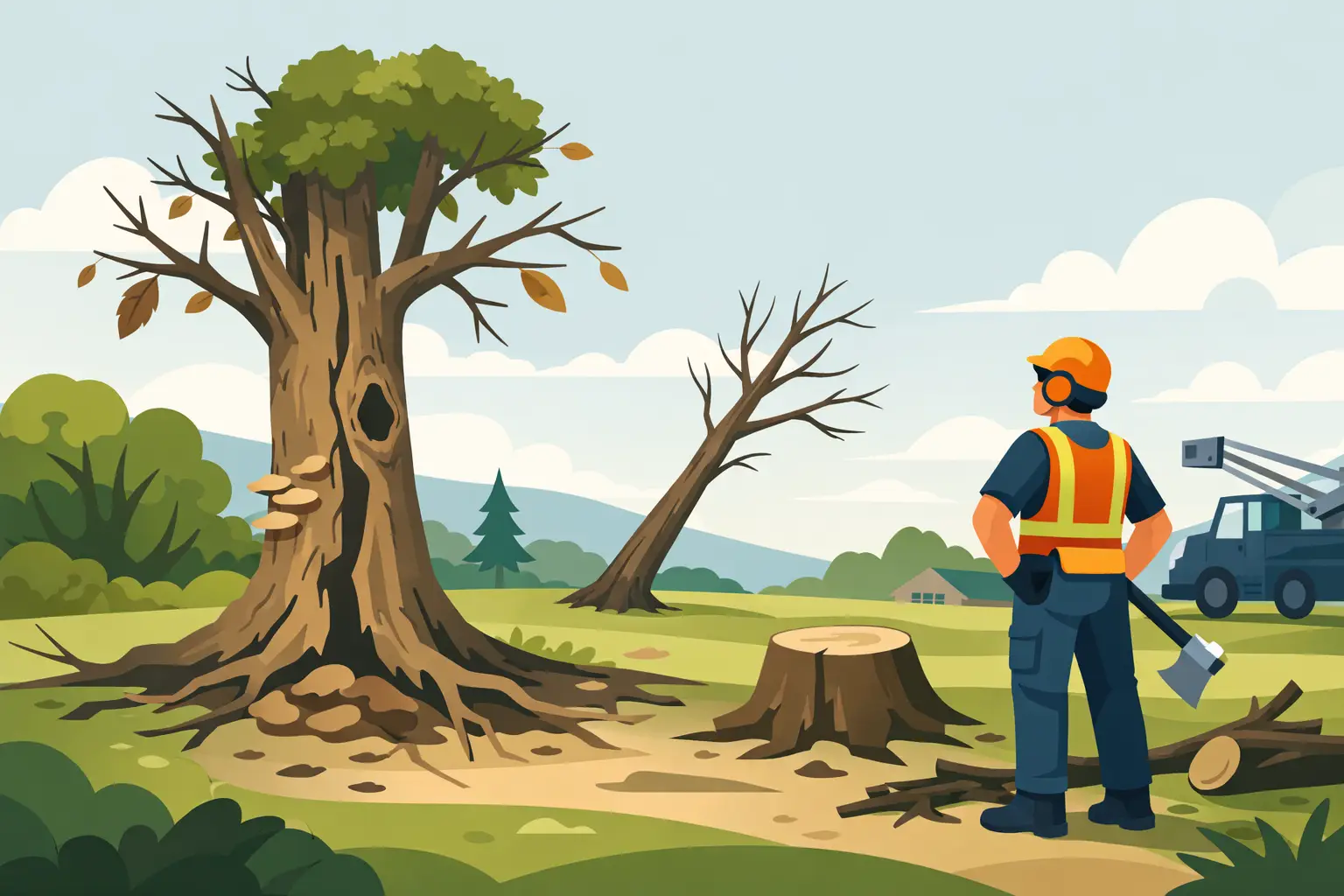
A tree can look fine from the street and still be one strong wind away from failing. That is usually the hard part for homeowners – figuring out how to tell tree removal is needed before a branch lands on a roof, a trunk splits, or root damage starts showing up in the yard.
In Plymouth and across the West Metro, trees take a beating from heavy snow, summer storms, wind, and changing ground conditions. Some problems are obvious. Others build slowly over time. If a tree is close to your house, driveway, garage, fence, or a neighboring property, waiting too long can turn a manageable job into an emergency.
How to Tell Tree Removal Is Needed Near Your Home
The biggest warning sign is not always a dead tree. In many cases, removal is needed when a tree becomes structurally unsafe, declines beyond recovery, or creates a clear risk to people and property. A healthy tree with poor structure can be more dangerous than a dead tree standing alone in the back of a lot.
Start with where the tree is located. A tree leaning over a home, hanging over a play area, growing too close to power lines, or crowding a garage deserves closer attention than one with the same condition in an open field. Risk depends on both the tree’s condition and what it could hit if it fails.
If you are seeing multiple warning signs at once, it is usually time to stop guessing and get it looked at by a professional crew.
The tree is dead or mostly dead
A dead tree is one of the clearest cases for removal. If a tree does not leaf out during the growing season, drops bark in large sections, has brittle limbs throughout the canopy, and shows no sign of new growth, it may already be gone.
Dead trees dry out, lose strength, and become unpredictable. Limbs can break without much warning, and the trunk can weaken faster than many homeowners expect. In a wooded area, a dead tree might be left standing in some situations. In a residential yard, especially near structures, removal is usually the safer move.
The trunk has major cracks, splits, or hollow areas
The trunk carries the load of the entire tree. When it shows deep vertical cracks, splitting seams, large cavities, or hollow sections, the concern is structural failure. Not every cavity means immediate removal, but size and placement matter.
A small wound in an otherwise healthy tree may be manageable. A large hollow area at the base or a split running through a main stem is different. If the damage affects the tree’s ability to support itself, pruning will not fix the problem.
The tree is leaning more than it used to
Some trees naturally grow at an angle, and that alone does not always mean trouble. What matters is whether the lean is new, increasing, or paired with root movement. If the ground is lifting on one side, roots are breaking, or the tree shifted after a storm, that is a red flag.
A sudden lean often points to root failure. Once that support is compromised, the tree can come down with little warning. This is especially serious when the tree is aimed at a house, driveway, sidewalk, or neighboring yard.
Signs Below Ground Matter Too
A lot of tree failure starts at the roots. The problem is that root issues can be easy to miss until the canopy starts declining or the tree begins to move.
Watch for heaving soil, exposed roots, mushrooms or fungal growth near the base, and soft or decayed wood around the root flare. Construction damage is another common factor. If roots were cut for a driveway, patio, utility work, or grading project, the tree may lose both stability and access to water.
Trees with serious root damage do not always fail right away. Sometimes they decline over several seasons, which makes the risk easy to underestimate.
Decay at the base of the tree
When decay is present where the trunk meets the ground, removal may be the safest option. That part of the tree handles a lot of stress. If it is rotting, the entire tree can become unstable.
You might notice crumbling wood, fungal conks, missing bark, or a hollow sound when tapping the trunk. A tree can still have leaves and look alive while major decay is developing at the base.
The roots are damaging surrounding areas
Removal is not always about collapse risk. In some cases, a tree needs to come down because the roots are damaging sidewalks, driveways, retaining walls, foundations, or underground lines. That does not mean every aggressive root system requires removal, but when repairs keep stacking up and the tree keeps expanding, the long-term cost can outweigh keeping it.
This is one of those situations where it depends on the tree species, age, location, and how severe the damage is. Sometimes root pruning or monitoring is enough. Other times, removal is the practical choice.
How to Tell Tree Removal Is Needed After Storm Damage
Storms change the picture fast. A tree that looked stable one day can be unsafe the next. If high winds, ice, or heavy snow have damaged a tree, look beyond the obvious broken branch.
Cracked unions, hanging limbs, twisted trunks, stripped bark, and fresh leaning all matter. A canopy that lost one major section may now be unbalanced, which increases the chance of future failure. If more than a small portion of the crown is gone, recovery becomes less likely.
After a storm, some trees can be saved with targeted pruning. Others are too compromised to trust near a home or parking area. If you see a partially fallen tree or limbs caught up overhead, keep your distance. That is not cleanup work for a ladder and chainsaw.
Decline in the Canopy Can Point to Bigger Problems
A thin canopy does not always mean removal is needed. Drought stress, insect activity, and disease can all cause temporary decline. But when canopy problems show up along with trunk damage, root issues, or dead scaffolding limbs, the tree may be in trouble.
Watch for dead branches throughout the crown, leaves that are small or sparse compared to prior years, sections that never leaf out, or early leaf drop during the growing season. If half the tree is dead, removal is often more practical than trying to prolong it.
That is especially true for trees near homes, garages, and shared property lines. Once decline reaches a certain point, the cost of repeated trimming and cleanup may not make sense.
When Removal Makes More Sense Than Pruning
Homeowners often hope pruning will solve the issue, and sometimes it can. If the problem is limited to a few overextended limbs, minor storm damage, or basic clearance concerns, trimming may be enough.
Removal makes more sense when the main structure of the tree is compromised, the decline is advanced, or the risk target is high. For example, a mature tree with trunk decay hanging over a roof is a different situation than a healthy tree needing branch reduction over a fence.
This is where clear communication matters. A good recommendation should explain why the tree can be pruned, monitored, or removed based on condition and location, not guesswork.
A Few Situations That Should Not Wait
Some tree problems need fast action. If a tree is split and still standing, leaning suddenly, touching a structure, or dropping large limbs, do not wait for the next storm. The same goes for trees with visible root lift or partial uprooting.
Property managers should take this seriously around parking lots, walkways, and tenant areas. Homeowners should do the same around driveways, patios, and places where kids play. The longer a hazardous tree stays in place, the fewer good options you usually have.
What to Do If You Are Not Sure
If you are unsure how to tell tree removal is needed, trust the pattern instead of one symptom. A single dead branch may just need pruning. A dead branch plus trunk cracks, canopy loss, and root problems is a different story.
Take a slow walk around the tree from several angles. Look at the base, trunk, canopy, and surrounding ground. Think about what the tree could hit if it failed. Then get a professional opinion before the issue turns urgent.
For homeowners and property managers in the West Metro, the best outcome is not just getting a tree down. It is getting the right recommendation, safe removal if needed, and a clean job site when the work is done. If a tree is giving you reasons to question it, that is usually reason enough to have it checked now, not after the next storm.