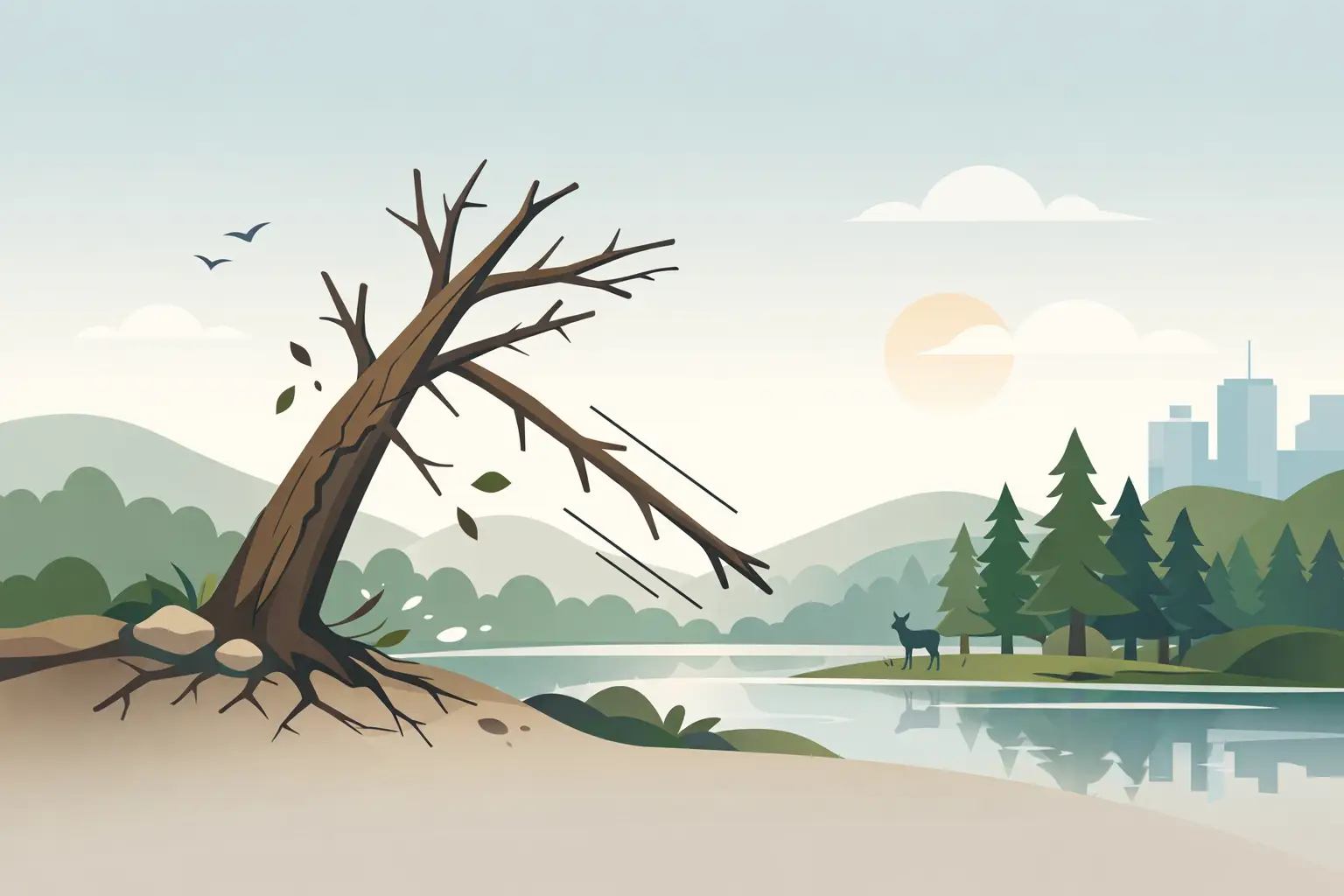
A dead tree does not wait for a convenient time to fail. If you are asking, can a dead tree fall anytime, the honest answer is yes. Some stand for years, while others come down after one windy afternoon, a heavy snow, or no obvious trigger at all.
That uncertainty is the problem. Once a tree is dead, it is no longer repairing damage, holding moisture the same way, or strengthening weak spots. In a yard near a house, driveway, sidewalk, fence, or neighboring property, that turns a dead tree from an eyesore into a safety issue.
Can a dead tree fall anytime or only in storms?
Storms raise the risk, but they are not the only reason dead trees fall. A dead trunk can split on a calm day. A large limb can drop with little warning when internal decay has already done the real damage. Wind, rain, ice, and snow often finish the job, but the failure usually starts earlier.
In Minnesota, seasonal weather makes this more serious. Freeze-thaw cycles open cracks. Wet spring soil can reduce root stability. Summer storms add strong gusts. Winter snow and ice load weak limbs and tops. If a tree is already dead, each season gives it another way to come apart.
That is why waiting to see what happens is risky. The question is less about whether a dead tree will fall and more about when, where, and what it will hit.
What makes a dead tree unstable?
Dead trees fail for different reasons, and not all of them look dramatic from the ground. Some trees still appear upright and solid, even when the trunk or root system has lost much of its strength.
One common issue is internal decay. The outside of the trunk may still have bark, but the wood inside can be soft, hollow, or brittle. Trees can also lose structural strength when insects, fungi, or old wounds break down the wood over time. In other cases, the roots are the weak point. If roots are decayed, severed, or lifting from the soil, the entire tree can tip instead of snapping.
Species matters too. Some dead trees become brittle faster than others. Size matters as well. A tall dead oak near a house is a different level of hazard than a small dead ornamental tree in the back corner of a lot. Location, lean, canopy spread, and nearby targets all affect the urgency.
Signs a dead tree may fall soon
A completely dead tree is never a good candidate for “wait and see,” but some warning signs suggest the risk is more immediate.
If the tree is dropping bark in large sections, has no living buds or leaf growth during the growing season, and shows major dead limbs throughout the canopy, it is already well past decline. Add a visible lean, soil lifting near the base, long trunk cracks, or fungal growth around the root flare, and the concern increases.
You may also notice hanging branches, cavities, hollow sounds when the trunk is tapped, or sections that look sunken and decayed. After storms, even minor ones, check whether the tree shifted, split, or shed new limbs. A tree that changes suddenly is a tree that needs attention quickly.
Not every hazard is obvious from the ground. Some trees look stable right up until they fail. That is one reason homeowners and property managers are better off treating dead trees as time-sensitive, especially when people, vehicles, or structures are nearby.
Why dead trees are more dangerous than they look
A living tree has some flexibility. It can move with wind, compartmentalize damage, and keep roots functioning. A dead tree loses that margin. Wood dries out, fibers weaken, and the structure becomes less forgiving under load.
That matters because tree failure is not always a clean, predictable event. A limb may break off over a driveway. The top may snap and fall into a roofline. The whole tree may uproot after rain softens the soil. Even if the tree does not fully collapse, partial failures can still cause injury and property damage.
For property managers, there is another layer to this: liability. If a dead tree is visibly hazardous and causes damage, the cost is not just cleanup. It can involve repairs, tenant complaints, access issues, and preventable claims. For homeowners, the same basic rule applies. Once a tree is clearly dead or unsafe, delaying action can become expensive.
Can you leave a dead tree standing?
Sometimes, but it depends on where it is and what surrounds it. In a large natural area away from structures and foot traffic, a dead tree may be left in place for habitat. In a typical residential yard in Plymouth, Minnetonka, Maple Grove, or the surrounding West Metro, that is usually not the best call if the tree could reach a home, garage, fence, patio, parked car, or neighboring lot.
The closer a dead tree is to something valuable, the less sense it makes to leave it alone. Even if it survives one season, it may be harder and more hazardous to remove later. As dead wood becomes more brittle, climbing and dismantling can get more complicated. Equipment access can also become tougher if the tree starts dropping limbs into the work zone.
There is also the practical side. A dead tree can affect curb appeal, interfere with mowing and yard use, and create constant worry during bad weather. Most owners would rather handle it on their schedule than after a late-night storm call.
What not to do with a dead tree
The biggest mistake is assuming that because the tree has not fallen yet, it is stable. Dead trees do not give guaranteed notice.
The second mistake is trying to remove one without the right equipment and planning. Dead trees can behave differently than healthy trees during cutting. Limbs may snap early. Tops can break unexpectedly. Hollow trunks do not always react the way they appear they should. If the tree is near a structure, utility lines, or tight property lines, the margin for error is small.
Even cleanup around a dead tree can be risky if broken limbs are hung up overhead. It is not just about dropping the trunk. It is about controlling the whole work area safely, protecting the property below, and getting everything hauled away cleanly.
When to call for removal
If the tree is dead and close enough to hit something, it is time to call. If it is leaning, shedding large limbs, showing cracks, or standing near a house, sidewalk, driveway, play area, or parking area, do not wait for a storm to make the decision for you.
A prompt estimate helps you understand the risk, the removal plan, and what access or protection steps may be needed. Good tree work is not only about cutting. It is about safe removal, protecting landscaping and structures, and leaving the site clean when the job is done.
For local properties, that often means looking at fence clearance, lawn impact, nearby roofs, and whether rigging or sectional removal is needed. A straightforward crew will tell you what the tree is doing, what the risks are, and how they plan to remove it without creating a bigger problem.
What to expect after a dead tree is removed
Once the tree is down, many owners choose to grind the stump so the area is usable again. That is especially helpful for front yards, mowing paths, rental properties, and spaces where a leftover stump becomes one more obstacle.
Hauling and cleanup matter too. Dead tree work can leave behind a lot of debris, from brittle limbs to sawdust and wood chunks. A professional job should end with the site cleaned up and the property looking better, not just safer.
If you have more than one questionable tree on the lot, this is also a good time to look around. Trees often decline in groups because of age, storm exposure, construction damage, or site stress. Catching the next problem early is easier than dealing with emergency damage later.
Xtreme Tree Service MN works with homeowners and property managers who need that kind of practical help – clear communication, safe removal, and a clean finish.
If you are looking at a dead tree and wondering whether it can wait, trust the part of you that already knows it is a risk. Dead trees do not get safer with time, and dealing with one before it fails is almost always the easier day.