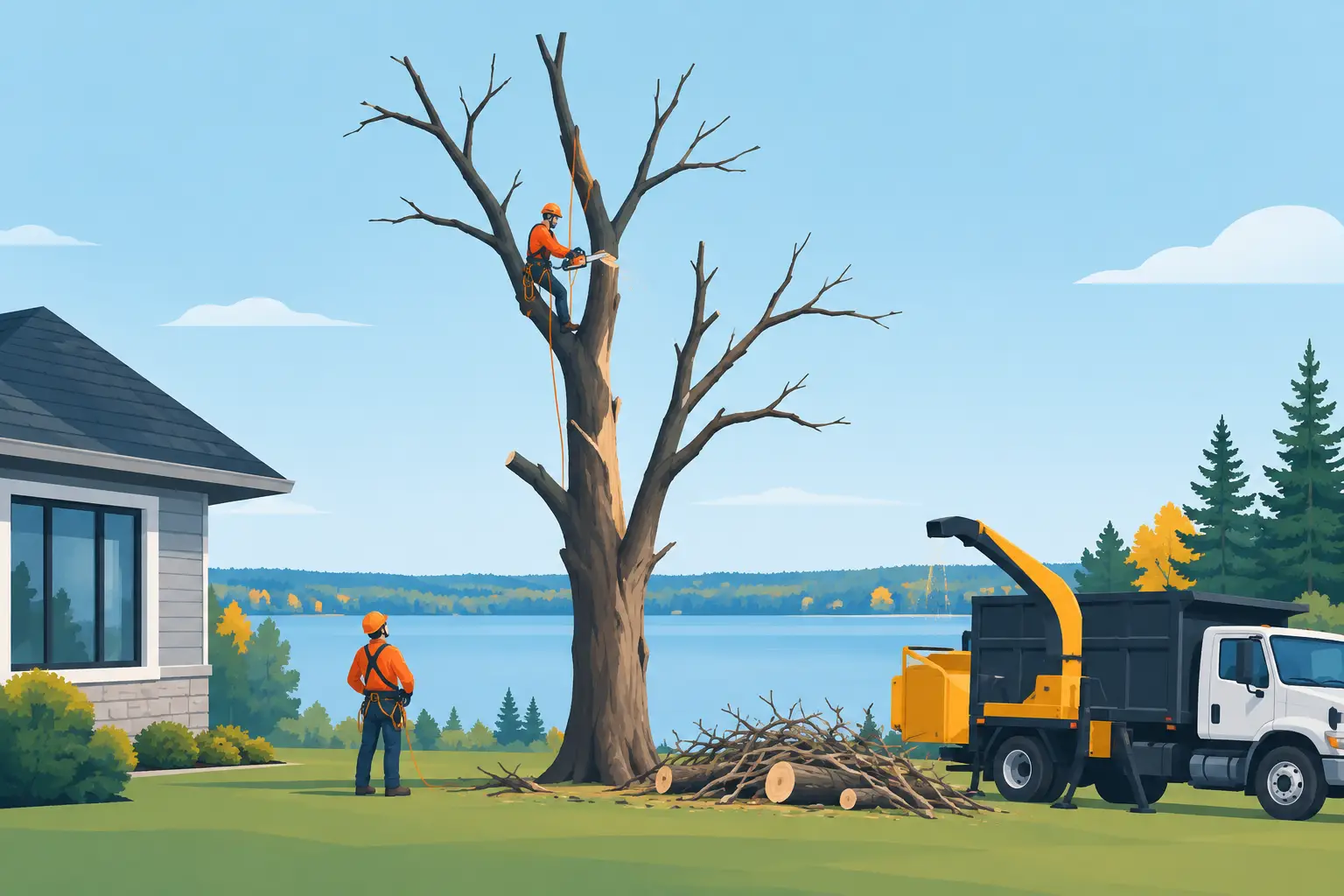
A dead ash standing over a Plymouth driveway may look like a problem that can wait until spring. Then a heavy, wet snowfall or a strong summer storm puts a large limb across the vehicles below. Dead trees do not get stronger with time. Dead tree removal is often the safest way to protect your home, people, vehicles, and nearby property before a failure turns into an emergency.
A tree can die slowly or all at once. Drought, disease, insect damage, root problems, construction damage, and severe weather can all leave a tree structurally unsound. The risk is not always obvious from the ground, especially when decay is hidden inside the trunk or root system.
Signs a Dead Tree Needs Removal
A fully dead tree usually has bare branches when surrounding trees are leafing out, brittle twigs, peeling bark, and no healthy buds. But removal decisions are not always that simple. A tree may have some living branches while a major leader, trunk section, or root system is already compromised.
Look closely for large dead limbs, deep cracks, cavities, fungal growth near the base, loose bark, and wood that feels soft or hollow. A trunk that is splitting, leaning more than it used to, or showing exposed roots deserves prompt attention. These signs do not automatically mean a tree will fail today, but they do mean the tree should be evaluated before the next storm tests it.
Location matters as much as condition. A dead tree in an open corner of a large lot may present less immediate risk than one near a house, garage, fence, play area, sidewalk, power line, or neighboring property. Even a smaller dead tree can cause expensive damage if it falls in the wrong direction.
In the West Metro, changing seasons add pressure. Frozen ground, heavy snow, ice, and high winds can all cause brittle branches and weakened trunks to break without much warning. Summer storms bring a different challenge: saturated soil and gusty winds can pull over trees with failing roots.
Why Waiting Can Make the Job Harder
Homeowners sometimes wait because the tree has stood dead for a year or two without incident. That is understandable, but a dead tree continues to deteriorate. As the wood dries and decays, branches become more likely to snap. The trunk may lose the strength needed for predictable cutting and controlled lowering.
Waiting can also limit the safest removal options. A crew may be able to climb and dismantle a tree while it still has enough sound wood for secure work positioning. Once the trunk becomes badly decayed, the work may require different equipment, more extensive rigging, or access from a bucket truck. Every property is different, but earlier removal can often reduce risk and keep the work more straightforward.
There is also the issue of access. A tree is easier to address before it drops limbs across a driveway, damages a roof, or becomes tangled with another tree. If a storm causes damage first, the project can shift from planned removal to emergency response, often when weather and site conditions are less favorable.
What Safe Dead Tree Removal Looks Like
Dead tree removal is not simply a matter of cutting at the base and hoping it falls into an open area. On a residential property, there are usually structures, landscaping, overhead obstacles, and tight working areas to consider. The right approach starts with a clear look at the tree’s condition, lean, decay, nearby targets, and access for equipment and cleanup.
For a tree with enough sound structure, a trained crew may remove it in sections. Branches are cut and lowered in a controlled way, followed by manageable pieces of trunk. This approach helps protect roofs, fences, gardens, patios, and neighboring yards when there is no safe space to fell the whole tree.
Some trees can be removed from the ground with a planned directional fall. That can be efficient when there is adequate room and the tree’s condition allows it. Other situations call for a bucket truck, ropes, rigging, or a crane. The best method depends on the tree, not on a one-size-fits-all process.
A professional job should also include site protection and cleanup. Before work begins, the crew should consider turf, landscaping, vehicles, gates, and structures in the work zone. After the tree is down, brush, logs, and debris should be handled according to the agreed plan so the property is not left looking like a storm just passed through.
Do Not Take on High-Risk Work Yourself
It is tempting to handle a dead tree with a chainsaw, especially when the tree does not seem large. The problem is that dead wood behaves differently than healthy wood. It can crack, break apart, or shift unexpectedly. A dead branch can fall while you are working below it, and a trunk with internal rot may not respond the way you expect during a cut.
Ladders add another level of risk. Using a chainsaw from a ladder or climbing into a dead tree puts you in a poor position if the branch, trunk, or ladder moves. The same goes for pulling on a leaning tree with a truck, rope, or winch. That can bring a tree down quickly, but not necessarily where you intended.
If the tree is near power lines, keep well away. Do not attempt to cut branches touching lines or use tools, ladders, or equipment near energized wires. Contact the utility provider if a line is involved, then arrange removal with a qualified tree service once the area is safe.
When Removal May Not Be the Only Answer
Not every tree with dead limbs needs full removal. A healthy mature tree may have a few dead branches caused by normal aging, minor storm damage, or shading. In those cases, selective pruning can remove the hazard while preserving the tree.
The key is the overall condition. If the trunk, main leaders, and roots are sound, targeted pruning may be the practical choice. If the tree is dead, has extensive decay, or has a major structural defect over a target, removal is usually the better long-term answer.
A site visit helps separate a manageable pruning project from a tree that has reached the end of its safe life. It also gives you a chance to discuss access, whether the wood should be hauled away, and whether stump grinding makes sense after removal. Grinding is useful when you want to reclaim lawn space, plant grass, install landscaping, or eliminate a tripping point. If the stump sits well out of the way, some property owners choose to leave it for later.
What to Expect From the Estimate Process
A clear estimate should begin with the tree itself and the conditions around it. The crew will consider height, diameter, lean, visible decay, proximity to structures, access to the backyard, and the amount of material that needs to be removed. A tall tree in a tight backyard naturally requires more planning than a small dead ornamental tree near the curb.
Ask what is included in the scope of work. Confirm whether brush and wood will be hauled away, whether the crew will rake and clean the area, and whether stump grinding is included or quoted separately. If access requires equipment to cross lawn areas, ask how the crew plans to protect the property and what conditions could affect scheduling.
For storm-damaged trees, take photos from a safe distance if you can. Do not stand under hanging limbs or walk into an unstable area to get a closer look. Share the photos when requesting an estimate, then let the crew assess the site in person.
A Practical Next Step for Plymouth Area Properties
If you have noticed a dead tree, a spreading crack, hanging branches, or a new lean after a storm, do not wait for the next weather event to make the decision for you. Clear information and a prompt on-site assessment make it easier to plan the work before the risk grows.
Xtreme Tree Service MN provides straightforward dead tree removal for homeowners and property managers across Plymouth and the West Metro. The goal is simple: safe removal, protection for the property, clear communication, and a clean site when the work is complete.
A dead tree rarely improves by being left alone. Addressing it on your schedule gives you more control over the work, the cost, and the condition of the property around it.
Leave a Reply