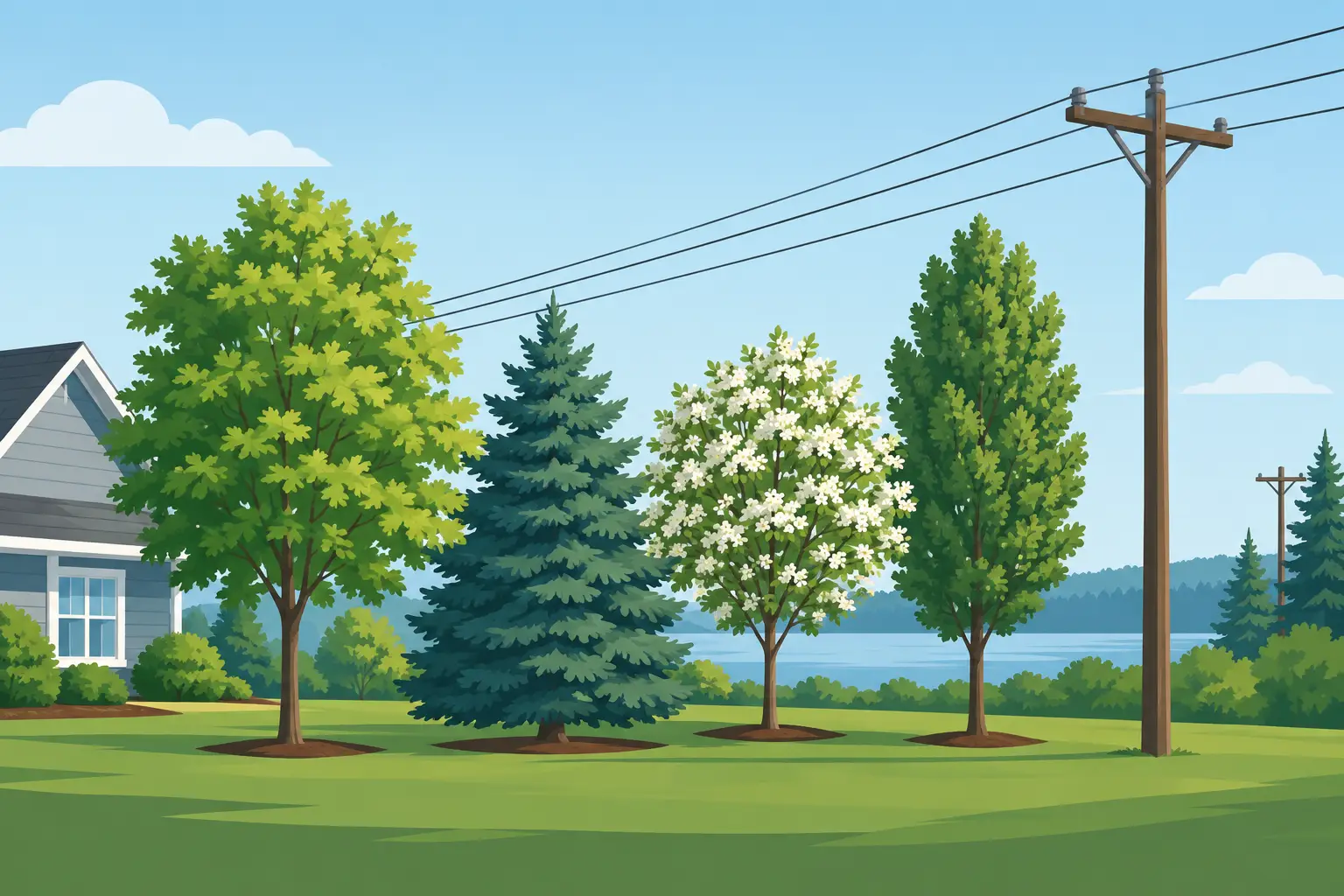
A tree that looks small at the nursery can become a costly problem when it grows into overhead wires. Choosing the best trees near power lines means looking beyond spring color or fall foliage. The right choice stays below the lines at maturity, fits your yard, and reduces future trimming, outage, and storm-damage concerns.
For homeowners and property managers in Plymouth, Minnetonka, Maple Grove, and the West Metro, planning matters. Minnesota snow, ice, wind, and fast summer growth can turn a poorly placed tree into a safety issue quicker than many people expect.
Start With the Mature Height, Not the Current Size
The main rule is simple: do not plant a tree directly under electrical lines if you can avoid it. If the location is the only practical place for a tree, choose a species with a mature height that remains well below the lowest wire.
Many overhead residential utility lines sit roughly 20 to 40 feet above the ground, but heights vary by neighborhood, pole placement, and line type. A tree advertised as “small” may still reach 25 or 30 feet. That can be too tall under a lower service line, especially once snow loads and wind bend branches upward.
As a general approach, trees expected to mature under 25 feet are the safest candidates for planting near distribution lines. Under a higher line, a tree in the 25- to 35-foot range may work with proper spacing, but it deserves a closer look. Taller shade trees should be planted well away from the utility corridor so their mature canopy has room to spread.
Do not assume regular pruning makes the wrong tree a good fit. Utility pruning is designed to keep branches clear of wires, not preserve the natural shape of every species. A large tree planted beneath lines may need repeated hard cuts that leave it uneven, stressed, and more vulnerable to decay.
Best Trees Near Power Lines in Minnesota
The best choice depends on sun exposure, soil moisture, room for roots, and whether the planting area is under wires or simply close to them. These smaller trees are often good options for Minnesota landscapes when planted with their mature size in mind.
Serviceberry
Serviceberry is a strong all-around choice for many West Metro yards. Most varieties grow about 15 to 25 feet tall, with a manageable spread. It offers white spring flowers, edible berries that birds enjoy, and orange to red fall color.
This tree can work near power lines when there is enough room for its canopy to develop without crowding the wires. It does best in full sun to partial shade and prefers well-drained soil. Like many ornamental trees, it can develop disease issues in some conditions, so proper pruning and airflow still matter.
Japanese Tree Lilac
Japanese tree lilac usually reaches 15 to 25 feet tall and has a rounded form that fits well in smaller yards. Its creamy white flower clusters appear in early summer, after many spring-flowering trees have finished.
It tolerates urban conditions fairly well and is often a practical choice for sunny locations. Give it enough space from driveways, roofs, and walkways. Even a modest-sized tree needs room for branches, snow removal, and access around the property.
Crabapple
Many crabapple varieties mature between 15 and 25 feet, making them a common choice under or near overhead lines. They provide spring flowers, compact form, and colorful fruit that can remain into winter.
Variety selection matters with crabapples. Some are more resistant to apple scab, fire blight, and cedar-apple rust than others. A disease-resistant variety can mean less leaf drop and fewer maintenance headaches. Avoid placing one where fallen fruit will create a mess on a heavily used walkway or parking area.
Eastern Redbud
Eastern redbud brings early pink-purple blooms and heart-shaped leaves to a landscape. It typically stays in the 20- to 30-foot range, although growth can vary with site conditions.
Redbud can be a good fit near higher overhead lines, but it may be less reliable in exposed, windy locations or poorly drained soils. In the Twin Cities area, choose a protected site and avoid low spots where water stands after rain or snowmelt.
Dwarf and Compact Ornamental Trees
Compact cultivars of trees such as magnolia, crabapple, and lilac can be useful where clearance is limited. Their final height is often more predictable than a standard species, but homeowners should still read the mature-size label carefully. A cultivar name does not automatically mean the tree will stay small enough for the location.
For very tight spaces directly beneath wires, a large shrub may be the better choice. Shrubs provide screening, flowers, and seasonal interest without creating a future utility conflict.
Trees to Keep Away From Overhead Lines
Large shade trees belong away from power lines, even if they are planted several feet to one side. Their mature branches can extend far beyond the trunk. In Minnesota, this includes silver maple, red maple, sugar maple, oak, elm, cottonwood, willow, spruce, pine, and many large birch varieties.
Fast-growing trees can be especially troublesome. They may provide quick shade, but rapid growth often means more frequent clearance work and weaker branch structure in some species. Cottonwoods and willows also drop limbs more readily during storms and can create repeated cleanup issues.
Evergreens deserve special attention. A young spruce planted under a line might look harmless for years, then steadily grow into the wires. Because conifers keep their lower branches and hold snow, they can become a significant clearance problem in winter.
Measure Side-to-Side Clearance Too
Height gets most of the attention, but width matters just as much. A tree planted beside a line can grow outward into it, especially if the line runs along the edge of a property or above a driveway.
Before planting, look up and trace the wire path across the yard. Consider the tree’s expected canopy width, not just the trunk location. Also account for the direction branches tend to grow toward sunlight. A tree on the north side of a line may reach toward the open, sunnier side as it matures.
Keep trees away from poles, transformers, guy wires, and utility access areas. Utility crews need clear access during outages, and planting too close can lead to damage when emergency repairs are needed.
Know Which Lines Are in Your Yard
Not all overhead wires are the same. The service line that runs from a utility pole to a house is different from higher-voltage distribution lines along the street. Cable and phone lines may sit lower than electric lines, but that does not make them safe to handle or prune around.
Never climb, cut, pull, or use a pole saw near any overhead wire. Branches can conduct electricity when wet, damaged, or touching a line, and a falling limb can pull a wire down with it. If a limb is resting on a power line or a wire is down, stay clear and contact the utility company immediately.
For underground utilities, call 811 before digging a planting hole. This is especially important near front-yard easements, street-side boulevards, and properties with irrigation, landscape lighting, or older utility layouts.
Plant for Less Maintenance Later
A good planting plan saves money over the life of the tree. Set the tree at the proper depth, keep mulch away from the trunk, and water consistently through the first few growing seasons. A healthy young tree establishes better structure and is less likely to need corrective work later.
Pruning should begin early, but lightly. Remove damaged limbs and address crossing branches while cuts are small. Do not top a tree to force it below power lines. Topping creates weak regrowth, ruins the tree’s form, and often brings the same clearance problem back within a few years.
If an established tree is already growing toward overhead lines, a professional assessment can help determine whether selective pruning, utility coordination, or removal is the safest path. Xtreme Tree Service MN handles tree trimming and removal with a focus on protecting nearby homes, landscaping, and structures while leaving the site clean.
A well-placed small tree can add shade, flowers, and curb appeal without becoming a recurring utility problem. Choose for the space the tree will need 15 or 20 years from now, and your yard will be safer and easier to maintain for years to come.
Leave a Reply