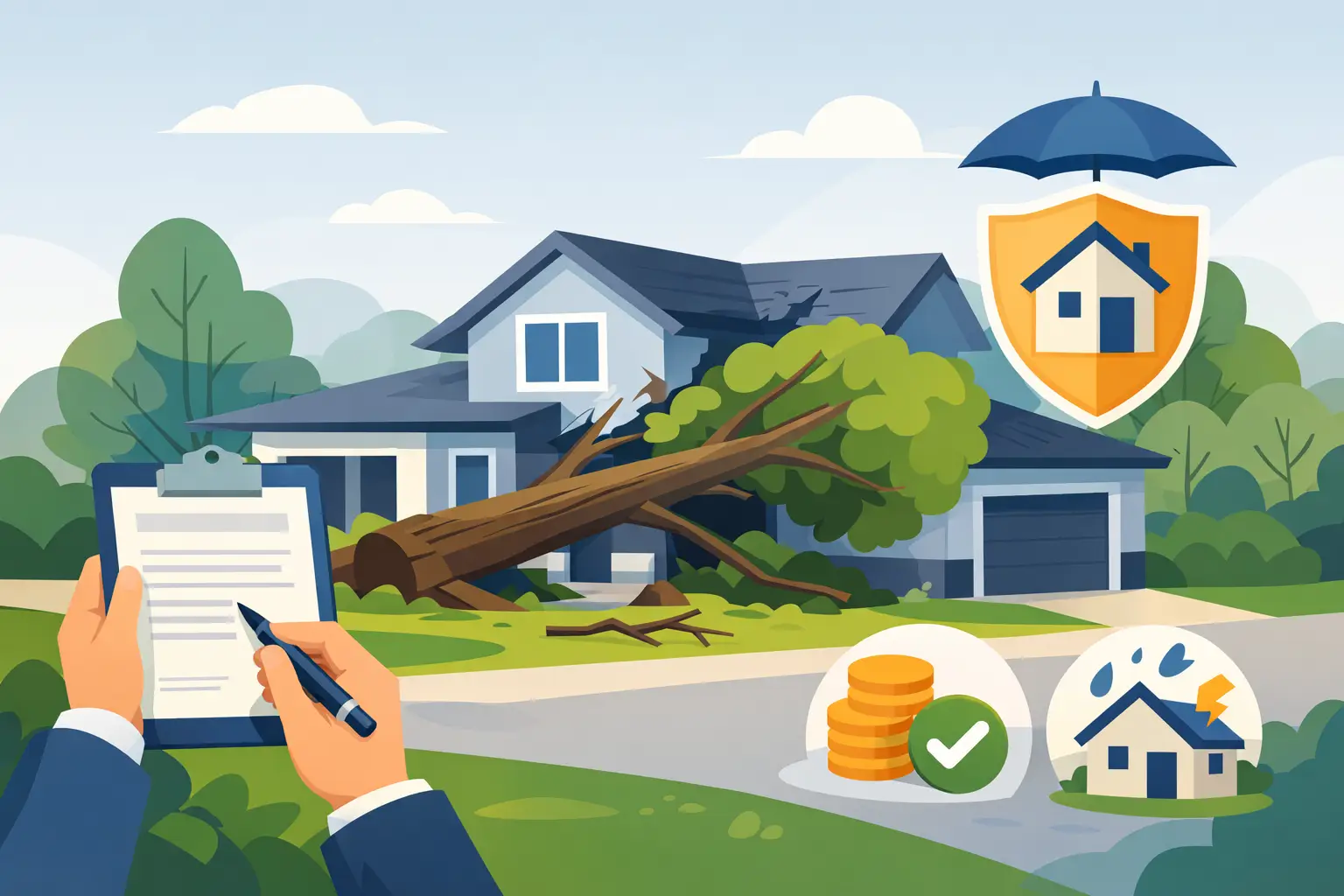
A tree comes down fast. One storm, one cracked trunk, one heavy snow, and now it is across the driveway, on the fence, or worse, against the house. In that moment, fallen tree insurance is not an abstract policy question. It becomes a real cost question, a safety issue, and a cleanup problem that needs a clear answer.
For homeowners in Plymouth and the West Metro, the short version is this: insurance often covers fallen trees, but not in every situation. What matters most is why the tree fell, what it hit, and whether the tree was considered a known risk before it came down. Those details decide whether your carrier pays for repairs, removal, both, or neither.
How fallen tree insurance usually works
Most standard homeowners policies may help when a tree falls because of a covered event such as wind, hail, ice, lightning, or the weight of snow. If that tree damages your home, garage, fence, or another insured structure, coverage often applies to the damage itself. In many cases, the policy also helps pay for removing the tree from the damaged structure.
That does not mean every fallen tree claim is automatic. If a tree simply drops in the yard and does not damage an insured structure, coverage can be more limited. Some policies still provide partial removal coverage if the tree blocks a driveway or wheelchair ramp, but others may not. Deductibles also matter. A removal bill may be smaller than the deductible, which means you end up paying out of pocket even if the event was technically covered.
This is where homeowners get tripped up. They hear that storm damage is covered and assume all tree work after a storm will be covered too. Sometimes that is true. Sometimes the damage is covered but the full cleanup is not. Sometimes only a capped amount is available for tree removal.
When insurance is more likely to pay
The most common covered scenario is straightforward. A healthy tree or large branch falls during a storm and strikes the house. In that case, the repair to the roof, siding, gutters, deck, or attached garage is usually the main claim, and tree removal is part of making those repairs possible.
Another common case is when a storm-damaged tree blocks access to the property. Some policies will pay a limited amount to remove the tree if it prevents you from using the driveway. That can be especially important after heavy wind or snow in Minnesota when access becomes a practical safety concern.
If the tree lands on a fence, shed, detached garage, or other covered structure, the same basic principle often applies. The structure damage may be covered, and the removal needed to complete repairs may also be covered, subject to policy limits.
When fallen tree insurance may not cover removal
Insurance is less likely to help when the tree fell because of neglect or pre-existing decay. If the tree was dead, visibly hollow, badly split, or leaning in a way that should have been addressed, the carrier may argue it was a maintenance issue rather than a sudden accidental loss.
That distinction matters. Homeowners insurance is built for unexpected events, not deferred upkeep. If a tree had obvious problems for months or years and then finally gave way, the insurer may deny the claim or limit what it pays.
Another common surprise is when a tree falls in the yard and hits nothing. If it misses the house, fence, and driveway, removal may be entirely on the property owner. The same can be true if the cleanup is considered routine debris removal rather than part of a covered property damage claim.
This is also why trimming and preventative removal matter. Paying for maintenance is not fun, but it is often far less expensive than dealing with a denied claim after a failure.
Whose insurance pays if the neighbor’s tree falls?
This is one of the biggest points of confusion. In most cases, if your neighbor’s tree falls onto your property because of a storm or other covered event, your insurance handles your damage. It usually does not matter whose yard the tree came from.
The exception is negligence. If the neighbor knew the tree was hazardous and failed to address it, there may be a case for their liability coverage to come into play. That is harder to prove than many people expect. You generally need something more than a bad outcome. Prior complaints, written notice, visible decay, or an arborist’s documented findings can make a difference.
Without that kind of evidence, each homeowner often turns to their own insurance first. That may feel unfair, but it is how many claims are handled in practice.
What to do right after a tree falls
Start with safety. Stay clear of downed power lines, unstable limbs, and trees that are resting against a structure under tension. A partially fallen tree can shift without warning. If there is immediate danger, call emergency services or the utility company first.
Once the area is safe, document everything. Take photos from multiple angles before cleanup begins. Get close-up shots of the point of impact, the tree base, visible decay if there is any, and the surrounding area. Insurers often ask how the tree failed, where it landed, and what it damaged.
Then contact your insurance company. Ask a direct set of questions: Is this likely covered, what is my deductible, is tree removal included, and do you need an adjuster to inspect before work starts? If the tree is creating an urgent hazard, tell them that clearly.
After that, call a qualified tree service. Fast response matters, but so does safe execution. Storm-damaged trees are unpredictable, especially when they are twisted into structures, suspended over roofs, or split at the trunk. This is not cleanup for a chainsaw and a guess.
Why the tree service estimate matters
A good estimate does more than give you a price. It helps define the work in a way that supports the claim. If a crew documents that the tree is on the house, over the garage, blocking the driveway, or resting on a fence, that can help show why removal is necessary and urgent.
It also helps to have a clear scope of work. Will the crew remove only the part on the structure, or the entire tree? Is hauling included? What about stump grinding later? Insurance may treat those items differently. Full site cleanup is often what homeowners want, but the policy may only reimburse certain parts.
This is where clear communication saves time. A straightforward contractor will tell you what work looks claim-related and what may be outside coverage.
Preventing a denied fallen tree insurance claim
The best way to protect yourself is to deal with warning signs early. Dead limbs, trunk cavities, root damage, fungal growth, sudden leaning, and repeated branch failure are all reasons to have a tree evaluated. Insurance companies do not expect every homeowner to be an arborist, but they do expect basic property upkeep.
If a tree is clearly failing, waiting is risky for two reasons. First, it can damage the home or injure someone. Second, if the damage looks preventable, your claim may get harder to support.
Routine pruning can reduce storm load and remove weak limbs before they fail. In some cases, full removal is the safer choice. For homeowners and property managers, that decision often comes down to a simple trade-off: pay now for planned work, or risk emergency work, property damage, and insurance complications later.
A local reality in Minnesota
In this area, tree failures are not limited to summer storms. Heavy wet snow, ice, saturated soil, and freeze-thaw cycles all put stress on mature trees. Maples split. Spruces uproot. Older trees with hidden decay can look fine until weather exposes the weakness.
That is one reason local response matters. Crews familiar with storm cleanup in Plymouth, Minnetonka, and Maple Grove know how quickly a manageable situation can turn into roof damage, blocked access, or a bigger liability issue. Companies like Xtreme Tree Service MN are often called in after storms because homeowners need quick estimates, safe removal, and thorough cleanup without a lot of back-and-forth.
The bottom line on fallen tree insurance
Fallen tree insurance can help, but it is rarely as simple as yes or no. Cause, condition, location, and policy language all matter. If the tree hit a covered structure after a storm, you may have a strong claim. If the tree was dead, neglected, or just lying in the yard, coverage may be limited or unavailable.
The practical move is to think about both sides of the problem. Know what your policy says before storm season, and deal with risky trees before they become emergency calls. When a tree does come down, document the damage, call your carrier, and bring in a crew that can remove it safely and leave the property in good shape. That approach gives you the best chance of a smoother claim and one less problem sitting in your yard.