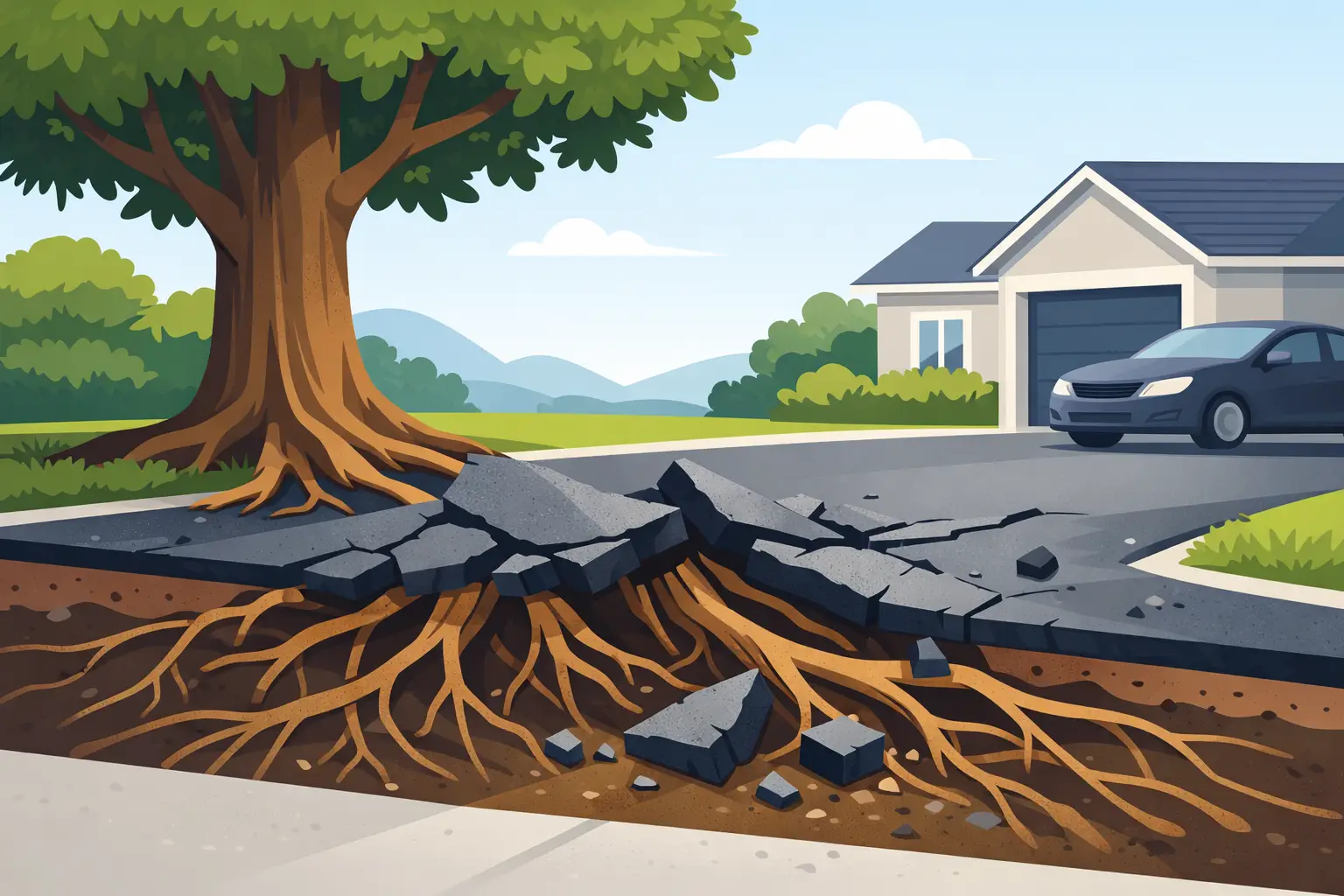
A driveway that starts lifting in one section or cracking near a large tree usually does not happen overnight. Homeowners often notice a small ridge, a widening joint, or a low spot that keeps getting worse. If you’re asking can tree roots damage a driveway, the short answer is yes – but the bigger issue is why it happens, how serious it is, and what to do before the damage spreads.
In the Plymouth and West Metro area, this comes up a lot with mature maples, ash, cottonwoods, elms, and other fast-growing shade trees planted close to concrete or asphalt years ago. The tree may look healthy above ground while the root system is quietly pushing against hard surfaces below. By the time the driveway changes are visible, the pressure has often been building for quite a while.
Can Tree Roots Damage a Driveway or Just Crack It?
Tree roots can damage a driveway in a few different ways. The most obvious is lifting, also called heaving, where part of the slab rises and creates an uneven surface. Roots can also contribute to cracking when they put pressure on weak points in the concrete or force slabs to move out of level. With asphalt, the damage may show up as rippling, splitting, or areas that soften and deform as roots expand underneath.
That said, roots are not always the only cause. Driveways also fail from poor base preparation, age, freeze-thaw cycles, drainage problems, or heavy vehicle loads. In Minnesota, winter movement adds another layer. A root-related problem can combine with frost heave and turn a minor issue into a tripping hazard or a more expensive repair.
This is why it helps to look at the whole site, not just the crack. If a driveway is damaged next to a tree, the root system may be part of the problem, but the extent of the damage depends on soil conditions, the type of driveway, and how close the tree is to the paved area.
Why Tree Roots Push Up Driveways
Roots do not usually “hunt” for concrete to break. They grow where moisture, oxygen, and soil conditions support growth. Near a driveway edge, roots often find compacted but workable soil, and over time they increase in diameter. As those structural roots thicken, they can press upward on the surface above them.
The issue is less about roots drilling through solid concrete and more about expansion and pressure. If the driveway was poured over shallow soil, if the base was thin, or if the slab already had a weak spot, the concrete has less room to tolerate that pressure. Asphalt is a little more flexible than concrete, but it can still deform when roots enlarge underneath it.
Large surface roots are usually not the first problem. More often, the trouble starts with roots a few inches below grade that are easy to miss until the driveway begins to move.
Trees Most Likely to Cause Trouble
Some species are more likely to create driveway issues because they grow fast, get large, or develop aggressive surface roots. Silver maples, Norway maples, cottonwoods, willows, and Siberian elms are common examples. Even oaks and other slower-growing trees can cause damage if they are planted too close to the driveway and allowed to mature.
Distance matters as much as species. A tree planted eight feet from a driveway carries a different risk than one planted twenty feet away. Soil type matters too. In compacted urban and suburban lots, roots often stay closer to the surface because deeper soil may have less oxygen.
Concrete vs. Asphalt
Concrete usually shows root damage as cracks, lifted panel edges, or separated joints. It can become a clear safety issue when one slab rises above the next. Asphalt tends to show broader distortion. You may see humps, waves, edge cracking, or weak spots where the surface no longer drains correctly.
Concrete often makes the problem easier to spot. Asphalt can hide it longer, especially if the surface has already aged or softened in summer heat.
Signs the Driveway Damage Is Root-Related
The location of the damage is the first clue. If cracking, lifting, or sinking is concentrated near a mature tree, especially along one edge of the driveway, roots should be considered. Surface roots nearby are another sign, though not every damaging root will be visible.
A few patterns show up often. One is a slab edge lifting closest to the tree. Another is a crack line that seems to track toward the trunk. You may also notice that the driveway drains differently than it used to, with water pooling where the surface has shifted.
Still, it is not always obvious. A driveway can crack from age alone, and a nearby tree can get blamed for damage it did not cause. That is one reason a site visit matters before anyone starts cutting roots or planning removal.
Should You Cut the Roots?
This is where many property owners make the problem worse. Cutting roots may reduce pressure on the driveway, but it can also destabilize the tree or start a decline that shows up months or years later. Large roots close to the trunk are especially important for support and health.
There is no safe one-size-fits-all rule. The tree species, size, condition, root location, and amount of root loss all matter. In some cases, selective root pruning may be possible. In other cases, cutting roots would create a higher risk than leaving the driveway alone for now.
If the tree is already stressed, leaning, decayed, or storm-damaged, root cutting can tip the balance in the wrong direction. For a large shade tree near a home, garage, or sidewalk, that is not a guessing game worth taking on without professional input.
When the Tree Should Stay and the Driveway Gets Repaired
Sometimes the best answer is to preserve the tree and address the pavement. That makes sense when the tree is healthy, well-placed overall, and the driveway damage is limited enough to repair or replace without major root loss. A contractor may be able to remove and repour a section, adjust grade, or redesign the edge to better accommodate existing roots.
This route often works better when the tree adds real value to the property through shade, privacy, and appearance. Mature trees take a long time to replace. If the root issue is manageable and the tree is structurally sound, keeping it can be the more practical long-term choice.
When Removal Becomes the Better Option
If the tree is too close, too large for the space, already causing repeat damage, or showing signs of decline, removal may be the cleaner solution. The same is true when root cutting would leave the tree unstable or when a full driveway replacement is planned and the root system is directly in the way.
For homeowners and property managers, this usually comes down to liability and repeat cost. If one tree is likely to keep lifting the driveway, interfere with future repairs, or create trip hazards near tenants or visitors, it may make more sense to remove it and prevent another round of damage.
That decision should be made carefully. Removing a tree affects shade, drainage, and the look of the property. But sometimes it is the option that protects the driveway, nearby structures, and overall site safety.
What to Do if You Think Roots Are Damaging Your Driveway
Start by paying attention to changes, not just major cracks. A slight lift at a panel joint, recurring puddles, or a driveway edge that suddenly looks uneven can all be early signs. Taking photos over time can help show whether movement is active.
Next, avoid quick fixes that ignore the cause. Patching over a root-related hump usually does not last. Neither does cutting exposed roots with no plan for the tree’s stability or health.
The practical step is to have both the tree and the site looked at before the damage gets worse. In many cases, the right answer is not just tree work or just concrete work. It is figuring out which problem is driving the other. A local crew that understands tree removal, root concerns, and property protection can help you avoid unnecessary damage while deciding the next step.
At Xtreme Tree Service MN, that usually starts with a straightforward look at the tree, the root area, and the risks around the driveway, home, and yard. The goal is simple – give the property owner a clear recommendation, do the work safely if needed, and leave the site clean.
A cracked driveway is frustrating, but it is also useful information. It tells you something below the surface is changing, and the sooner you deal with it, the more options you usually have.