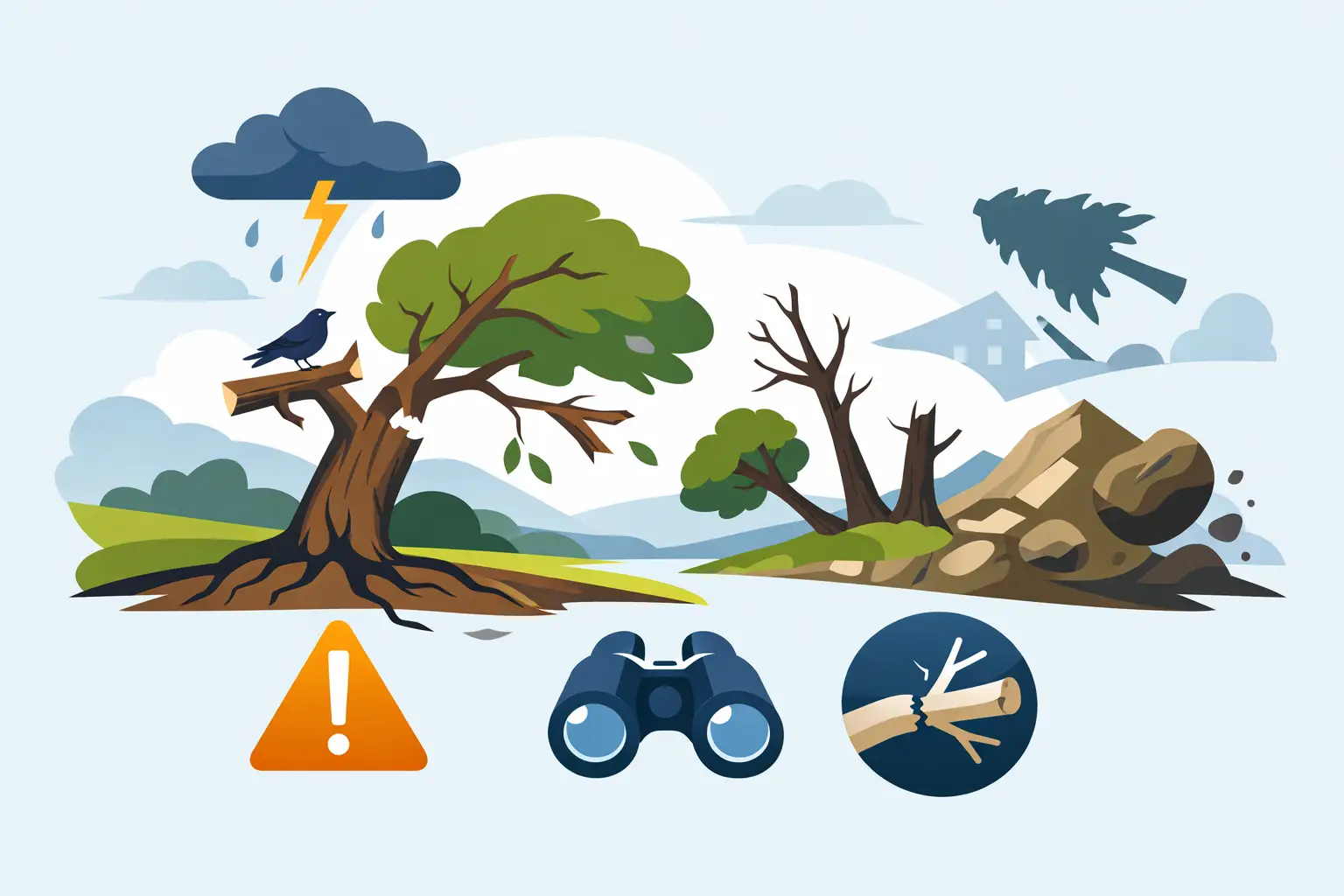
A mature tree can look solid from the driveway and still have a serious structural problem. The warning signs of unstable trees are not always dramatic, especially when decay or root damage is hidden below the surface. Knowing what to look for can help homeowners and property managers act before high winds, heavy snow, or saturated ground turn a concern into property damage.
Not every leaning tree needs to come down, and not every crack means failure is close. What matters is the tree’s overall condition, where it is located, and whether the problem is getting worse. A tree over an open corner of the yard presents a different level of risk than the same tree hanging over a roof, driveway, sidewalk, or neighboring property.
Warning Signs of Unstable Trees to Take Seriously
1. A new or worsening lean
Some trees naturally grow at an angle, particularly if they have spent years reaching toward sunlight. A long-standing lean is not automatically dangerous. A lean that appeared recently, became more noticeable after a storm, or points toward a home or heavily used area deserves prompt attention.
Look at the ground around the base. Raised soil, exposed roots, or a gap opening on the side opposite the lean can mean the root plate is moving. That is a more urgent issue than a tree that has simply grown at an angle over time.
2. Cracks in the trunk or major limbs
Vertical cracks, deep splits, and separations where large limbs join the trunk can weaken a tree’s ability to handle wind and snow load. A crack may be visible only on one side, so walk around the tree if it is safe to do so.
Pay close attention to a crack that runs through a branch union, especially when two main stems form a tight V shape. These unions can trap bark between the stems instead of creating a strong connection. The tree may hold together for years, but a heavy storm can expose the weakness quickly.
3. Dead, hanging, or broken branches
Dead branches do not always mean the whole tree is failing. They do create an immediate falling hazard, particularly when they are large or hanging above a deck, driveway, play area, or walkway. Broken limbs caught in the canopy can come down without much warning when the wind picks up.
Branches with no leaves during the growing season, peeling bark, or brittle twigs are often dead. Do not try to pull down a large hanging limb from the ground or climb up to cut it. The branch may shift unexpectedly, and nearby limbs or power lines can add to the danger.
4. Mushrooms or decay at the base
Mushrooms growing from the trunk flare, roots, or soil near the base can be a sign that fungi are breaking down wood below ground or inside the tree. This does not tell you exactly how much sound wood remains, but it is a reason to have the tree assessed.
Soft, crumbly wood, hollow areas, cavities, and missing bark around the lower trunk are also concerns. Trees can sometimes compensate for internal decay, but the risk rises when decay is combined with a lean, root damage, or a large canopy over a target area.
5. Root damage or lifting soil
Roots anchor the tree and supply it with water and nutrients. Construction work, trenching, driveway installation, soil changes, and heavy equipment traffic can damage roots without showing immediate effects in the canopy. Problems may not become clear until months or years later.
After a period of rain, inspect for soil heaving near the base, newly exposed roots, or cracking ground. These signs can indicate movement in the root system. If a tree is close to your home, garage, fence, or parking area, treat visible root movement as a priority.
6. A sparse or dying canopy
A thinning canopy, bare sections, undersized leaves, or branches dying back from the tips may point to stress, disease, insect damage, or root problems. One weak season does not always mean the tree is unstable. Drought, late frost, and transplant stress can affect leaf growth.
Still, widespread dieback is worth checking, especially when paired with trunk defects or decay. A tree that is losing major limbs over time can become unbalanced, placing extra load on the remaining trunk and roots.
7. Peeling bark and deep wounds
Bark damage is not always cosmetic. Large areas of missing bark can expose the living tissue beneath and make it easier for decay organisms to enter. Deep wounds from lawn equipment, vehicles, construction activity, or old storm damage can create long-term structural issues.
Look for wounds that do not appear to be closing around the edges, areas that feel soft, or bark that is falling away around a cavity. A professional inspection can help separate a surface injury from a defect that affects the tree’s stability.
8. Large branches growing over a target
A healthy-looking limb can still create a risk if it is oversized, poorly attached, heavily extended, or growing directly over a roof. This is common with mature maples, oaks, cottonwoods, and other broad-canopy trees found throughout the West Metro.
The concern increases when a limb has a visible crack, old pruning stub, hollow spot, or weak union. Proper pruning can sometimes reduce weight and improve clearance. In other cases, removal is the safer choice. The right option depends on the tree’s condition and how much of the property is within its fall zone.
9. Storm damage that changes the tree’s shape
After wind, ice, or heavy wet snow, inspect trees for broken leaders, split trunks, twisted branches, and new leaning. Even if nothing has fallen, a storm may have weakened a branch connection or shifted the root system.
Do not assume a tree is safe because it remained standing through the storm. A partially split limb can stay in place until the next wind event. If branches are touching utility lines, stay clear and contact the utility provider. Tree crews should not work around energized lines unless they are qualified and equipped for that work.
10. Changes you can hear or feel
A creaking trunk or major limb in the wind is not something to ignore, particularly if it is new. You may also notice a tree moving more than usual at the base, a fresh crack opening during gusts, or soil shifting around the roots.
Keep people, vehicles, and pets away from the area until the tree can be evaluated. Do not park beneath it or try to brace it with rope. A failing tree can move suddenly, and improvised fixes can put you directly in the danger zone.
What to Do When a Tree Looks Unstable
Start by creating distance. Keep children, pets, and vehicles outside the likely fall area, and avoid walking under damaged limbs. Take photos from the ground if it is safe, especially after a storm. Pictures can help document changes and give a tree professional a clear first look at the issue.
Next, consider the target. A tree with decay in a back corner of a large lot may allow time for a planned removal or pruning visit. A cracked trunk above a bedroom, driveway, sidewalk, or shared property line calls for faster action. If there is an immediate threat to people, a structure, or a utility line, do not wait for the next storm.
Avoid climbing, using a ladder, or cutting large limbs yourself. Tree work is unpredictable because weight shifts as cuts are made, and damaged wood does not always break where expected. The risk is even higher when the tree is leaning, hollow, storm-damaged, or close to structures.
When Pruning Can Help and When Removal Makes Sense
Pruning may be appropriate when the main issue is deadwood, overextended branches, or canopy weight that can be reduced without harming the tree’s structure. Good pruning focuses on clear objectives such as removing hazardous limbs, improving clearance, or reducing stress on a weak branch.
Removal is often the better call when a tree has major root failure, severe trunk decay, a large split, repeated branch failures, or a lean that threatens a home or high-use area. There is no one-size-fits-all answer. Tree species, size, location, defects, and access all affect the safest plan.
For homeowners in Plymouth, Minnetonka, Maple Grove, and nearby West Metro communities, Xtreme Tree Service MN can assess concerning trees, explain the options clearly, and handle safe removal, pruning, or storm cleanup when needed. The goal is to protect the property and leave the work area clean when the job is done.
If a tree gives you pause every time the wind starts blowing, trust that instinct. A quick assessment now can prevent a stressful emergency later.