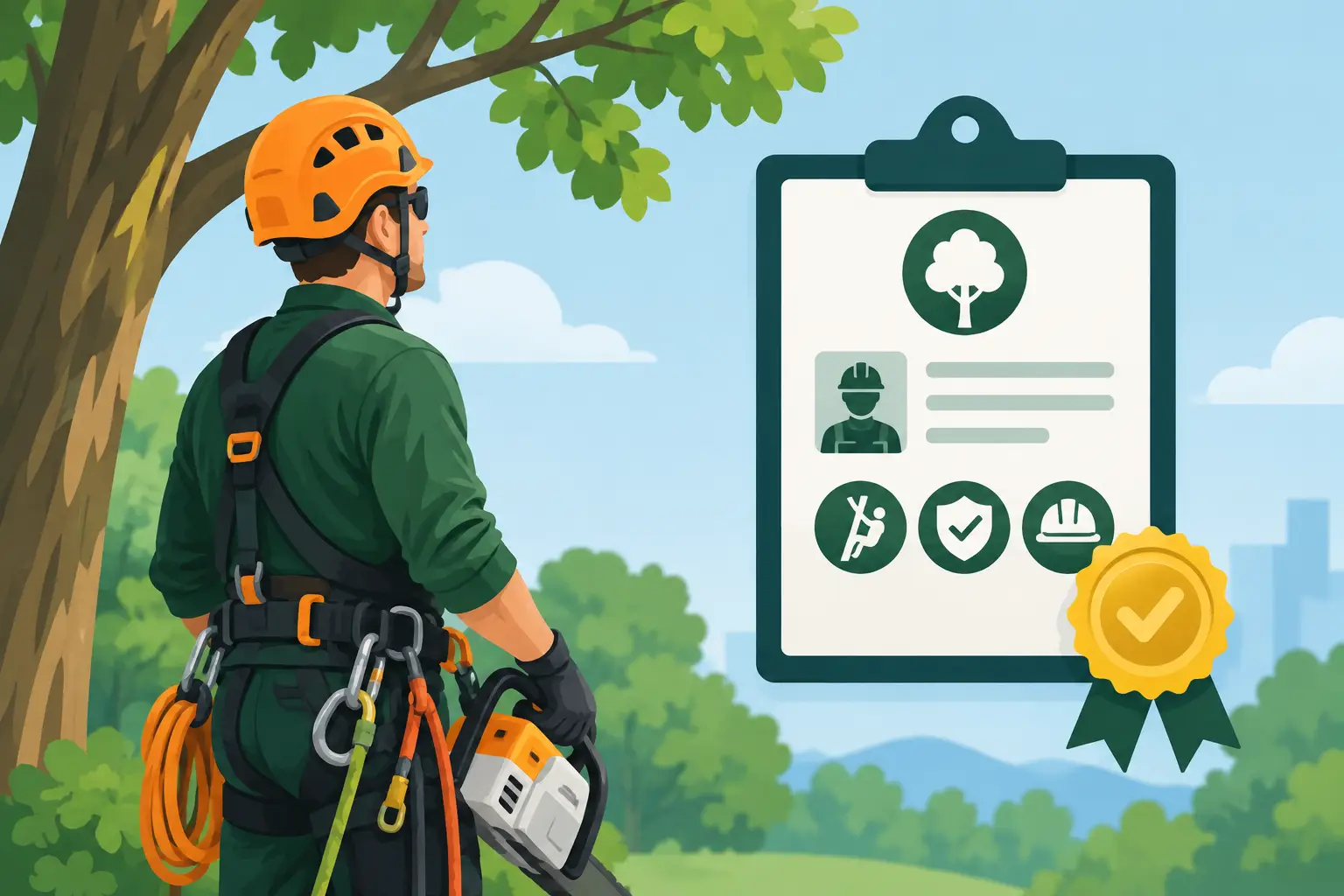
A tree crew may be working over your roof, near a power line, or above the driveway where your family parks. That is why an arborist credentials review should happen before the first cut, not after a problem occurs. Credentials do not replace experience or careful job planning, but they give homeowners and property managers a clear way to separate qualified tree professionals from someone with a truck and a chainsaw.
For properties in Plymouth, Minnetonka, Maple Grove, and the West Metro, the right qualifications depend on the job. Pruning a mature oak, removing a dead tree beside a garage, and cleaning up storm-damaged branches each bring different risks. A good contractor should be able to explain who will do the work, how the site will be protected, and what coverage is in place if something goes wrong.
What arborist credentials actually tell you
The word “arborist” is used broadly. It can describe a highly trained tree care professional, but it is not proof by itself that a company carries certification, insurance, or the equipment needed for difficult removals. Ask what the company means when it uses the term.
A credential is most useful when it shows training in a specific area of tree care. It may indicate knowledge of tree biology, pruning standards, hazard recognition, climbing practices, aerial lift operation, or jobsite safety. It should support the work being proposed, not serve as a vague marketing label.
The most recognized individual credential in residential tree care is ISA Certified Arborist. ISA stands for the International Society of Arboriculture. Certification generally requires documented experience or education, passing an exam, and continuing education to keep the credential current. That makes it a meaningful signal that a person understands accepted tree care practices.
Still, certification does not mean every person on the crew has the same training. It also does not guarantee a company will communicate well, protect your lawn, show up on schedule, or leave the site clean. Those are earned through field experience and company standards. Treat credentials as one part of the hiring decision.
Arborist credentials review: what to verify first
Start by asking who will inspect the tree and who will be on the jobsite. A company may have a certified arborist involved in estimates while another crew performs the work. That can be perfectly reasonable, as long as the scope is clear and the crew is properly trained for the work.
For pruning, ask whether the recommendation follows accepted pruning practices. Qualified professionals should be able to explain why branches are being removed and avoid proposing harmful shortcuts such as topping. Topping leaves large wounds and weak regrowth, and it often creates more maintenance problems later.
For tree risk assessment, look for additional training. ISA Tree Risk Assessment Qualification, often called TRAQ, is designed for professionals who evaluate tree defects, targets, and the likelihood of failure. It can be especially helpful when a large tree has decay, cracks, root damage, or limbs extending over a house, sidewalk, play area, or parking space.
For removal work, the most relevant proof may be practical rather than a single certificate. Ask about the crew’s experience with trees of similar size and location. A straightforward backyard removal is different from dismantling a compromised tree in sections beside a fence, utility line, or roof. The contractor should describe whether the work requires climbing, a bucket truck, rigging, crane support, or controlled lowering of limbs.
Insurance is not optional paperwork
Credentials matter, but insurance is the basic protection every property owner should verify. Tree work has real risk. A falling limb can damage siding, windows, vehicles, landscaping, or neighboring property. A worker can also be injured on the job.
Ask for current proof of general liability insurance and workers’ compensation coverage. Do not assume that a business license, an online profile, or a verbal assurance means the coverage is active. A professional company should be prepared to provide documentation when requested.
General liability coverage addresses accidental property damage or injury to others. Workers’ compensation is different: it covers employees injured while working. Without proper workers’ compensation coverage, a homeowner could face unwanted exposure if an uninsured worker is hurt on the property.
Be cautious if a quote is dramatically lower than the others and the contractor is vague about insurance. Lower overhead can sometimes mean a fair price, but it can also mean missing coverage, inadequate equipment, or a crew that plans to rush the work. Tree removal is not a job where cutting corners stays cheap for long.
Match the qualifications to the scope of work
The best company for routine pruning may not be the best fit for a complex emergency removal. Use the proposed work to guide your questions.
A healthy shade tree that needs clearance from the roof or driveway calls for good pruning knowledge and careful cleanup. A large dead ash near a home calls for removal experience, equipment planning, and strong property protection. A storm-damaged tree with hanging limbs calls for fast response, hazard control, and a crew that knows when a situation is too dangerous to address immediately.
Property managers should also ask how the company handles access, tenant communication, traffic flow, and debris removal. A crew may be technically capable but still create avoidable disruption if the work area is not planned well. For commercial and multi-property sites, clear scheduling and site coordination matter nearly as much as the cutting itself.
There are times when another specialist should be involved. If branches are near energized utility lines, contact the utility provider or use a company qualified for line-clearance work. If a tree is part of a boundary dispute, protected by a local ordinance, or showing signs of a serious disease problem, get the proper guidance before scheduling removal. A responsible tree company will not pretend every situation has the same answer.
Questions that reveal a professional crew
You do not need to be a tree expert to ask useful questions. Pay attention to whether the answers are specific and practical. A qualified contractor should be able to walk you through the plan without hiding behind technical language.
Ask how the crew will protect the house, garage, fence, landscape beds, and driveway. Ask where equipment will be staged and whether ground mats are needed to reduce lawn damage. If the tree is close to a structure, ask how limbs and trunk sections will be lowered instead of dropped.
It also helps to confirm what the price includes. Make sure the written estimate identifies the tree or trees, the planned service, debris hauling, wood handling, and whether stump grinding is included or separate. Cleanup is not a minor detail. A clear scope prevents surprises after the crew leaves.
Finally, ask what happens if the crew finds hidden decay, unstable limbs, or another condition that changes the plan. Tree work can uncover problems that are not visible from the ground. A professional should explain any change in cost or method before proceeding whenever the situation allows.
Watch for claims that do not add up
A polished logo or a long list of services is not the same as proof of qualification. Be careful with companies that advertise “licensed and insured” but cannot provide details, refuse to put the scope in writing, or pressure you to decide immediately.
Other warning signs include recommendations to top healthy trees, vague explanations of how a difficult tree will come down, and estimates that leave cleanup undefined. Be equally cautious of anyone who knocks on the door after a storm and wants payment before the work is completed. Storm damage creates urgency, but it should not force a rushed hiring decision when there is no immediate life-safety threat.
Reviews and referrals can help, especially when they mention similar work, clean job sites, and respectful communication. They should not be the only factor. A neighbor may have had a good experience with a small pruning job, while your situation involves a much larger removal beside a house.
A better way to choose tree service
The goal is not to find a contractor with the longest list of initials. The goal is to hire a crew that is qualified for your specific tree problem, insured for the work, honest about the risks, and organized enough to protect your property from start to finish.
At Xtreme Tree Service MN, that means clear estimates, safe removal and pruning methods, and thorough cleanup once the work is done. If you are comparing tree service options, ask direct questions, review the paperwork, and choose the team that gives you clear answers before the equipment arrives.