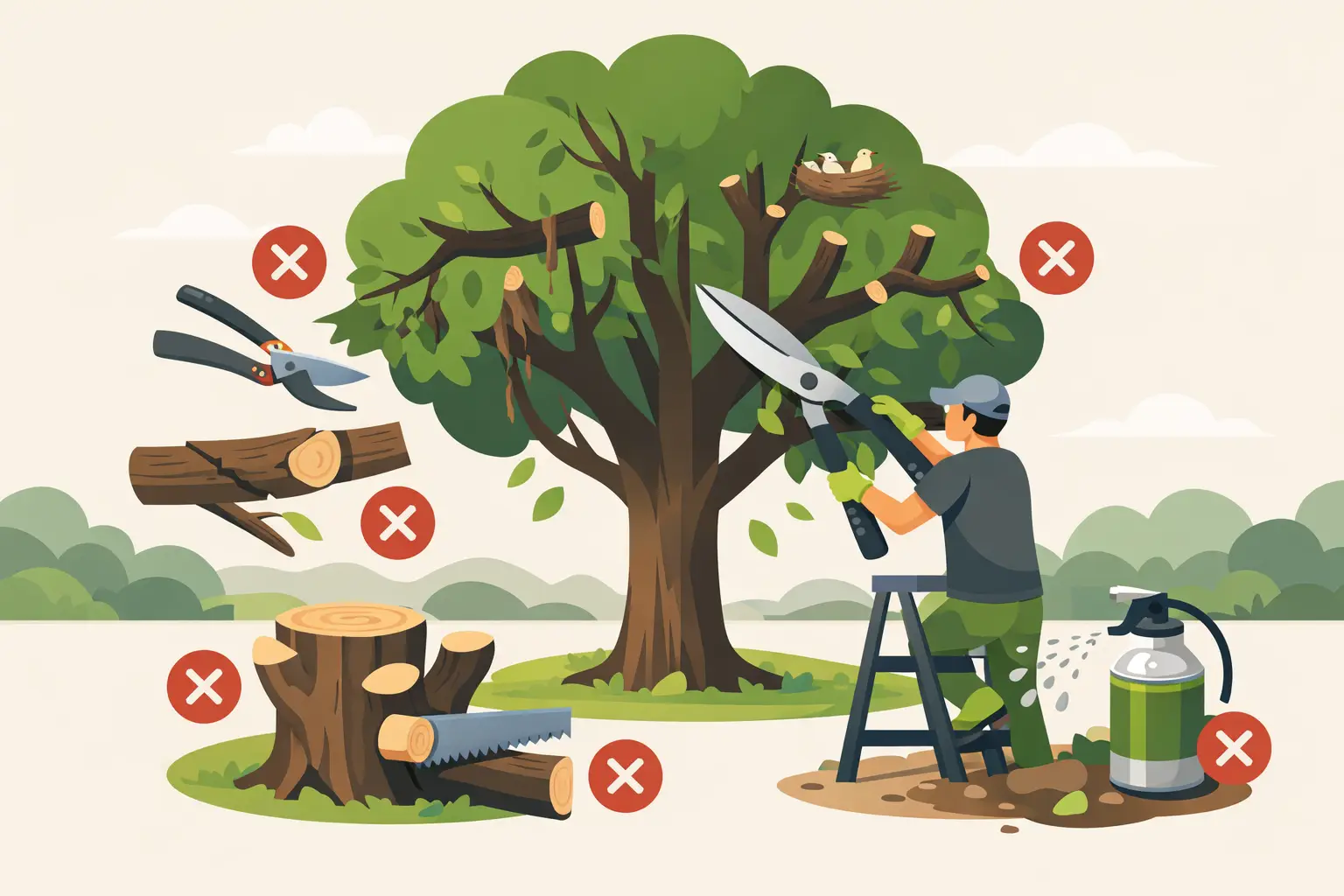
A branch rubbing on the roof, hanging over a driveway, or blocking a window can make pruning feel like a quick weekend job. But tree pruning mistakes can do more than leave a tree looking uneven. The wrong cut can weaken a major limb, create an entry point for decay, or make a mature tree less stable in the next Minnesota windstorm.
For homeowners and property managers in Plymouth, Minnetonka, Maple Grove, and nearby communities, the goal is not to remove as much growth as possible. Good pruning removes the right growth for a clear reason: safety, structure, clearance, or tree health. Here are the mistakes that cause the most trouble and what to do instead.
1. Topping a Tree to Make It Shorter
Topping means cutting major branches or the main trunk back to stubs. It is often done when a tree has grown too tall for its location or is getting close to utility lines, a roof, or another structure.
The problem is that a topped tree often responds by sending out multiple fast-growing shoots below the cuts. Those new shoots are weakly attached and can become a future failure point. Large topping wounds also have a harder time sealing over, which raises the chance of decay inside the limb or trunk.
If a tree is simply too large for its space, selective reduction pruning may be an option. This shortens specific limbs back to a healthy lateral branch that can take over the growth. It is a more careful process, and it does not work for every tree. In some cases, especially with a declining or poorly placed tree, removal is the safer long-term answer.
2. Removing Too Much Canopy at Once
A common assumption is that a heavily thinned tree will be safer in the wind. In reality, removing too much live canopy can stress the tree and trigger aggressive regrowth. It also exposes previously shaded bark and branches to more sun, which can cause damage on certain species.
As a general rule, avoid removing more than about 20 to 25 percent of a healthy tree’s live canopy in one season. The right amount depends on the tree’s age, species, condition, and the reason for pruning. A young tree can benefit from structural pruning, while a mature oak with signs of decline may need a much lighter approach.
If several large limbs need attention, it may be better to spread the work over more than one season. That is not always possible when there is an immediate hazard, but it is a better plan for routine maintenance.
3. Making Flush Cuts or Leaving Long Stubs
Where a branch meets the trunk, there is usually a slightly raised area called the branch collar. This area helps the tree form protective tissue over a pruning wound. Cutting into it with a flush cut removes that natural defense zone.
Leaving a long stub creates the opposite problem. The stub may die back and decay before the tree can close the wound, creating a path for rot to move inward. A proper cut is made just outside the branch collar, without cutting the collar itself and without leaving extra branch wood behind.
This may sound minor, but cut placement is one of the biggest differences between pruning that supports tree health and pruning that creates a long-term defect. Large limbs also need a controlled multi-step cut to prevent bark from tearing down the trunk as the branch falls.
4. Pruning at the Wrong Time of Year
Timing matters, especially in the West Metro where winter cold, spring moisture, and summer storms all affect trees differently. Dormant-season pruning is often a good choice for many deciduous trees because the branch structure is easy to see and certain pests are less active.
However, there is no single calendar date that fits every tree. Oaks deserve special care because pruning during high-risk periods can increase exposure to oak wilt. Spring-flowering trees can lose their seasonal display if they are pruned before blooming. Trees damaged in a storm should be addressed when conditions are safe, regardless of the season.
Routine pruning is usually easier to schedule than emergency work. If you are unsure whether a branch can wait, look for cracks, hanging limbs, split branch unions, sudden leaning, or fresh damage near the trunk. Those conditions call for a professional assessment rather than waiting for the ideal pruning window.
5. Treating Every Crossing Branch as a Problem
Crossing, rubbing, or inward-growing branches can be worth addressing, but not every one needs to come out immediately. Pruning is a series of trade-offs. Removing a small rubbing branch from a young tree can prevent a future wound. Removing a large mature limb just because it crosses another branch may leave a bigger problem than the one you were trying to fix.
Start with branches that are dead, broken, diseased, or creating a real safety issue. Then consider structure. Two large stems growing from the same point, especially with a tight V-shaped connection, may be more concerning than two smaller branches that touch occasionally.
A trained crew can decide whether selective pruning will improve the tree’s structure or whether a cable, bracing system, or removal should be considered. The answer depends on the tree, the defect, and what sits below it.
6. Using Dull, Dirty, or Incorrect Tools
Dull tools crush wood instead of making clean cuts. Dirty tools can spread disease from one tree to another. Using the wrong tool can also lead to uncontrolled cuts, torn bark, or a branch falling where it should not.
Hand pruners and pruning saws are useful for smaller branches within reach. Once a job requires climbing, working near a roof, using a chainsaw overhead, or lowering limbs over landscaping, it is no longer simple yard maintenance. It becomes tree work with real injury and property-damage risk.
Keep tools sharp and clean, and do not use a ladder with a chainsaw. A branch can shift under tension, a ladder can move, and one bad cut can put the operator directly in the fall path.
7. Pruning for Clearance Without a Drop Zone Plan
Many costly tree pruning mistakes happen after the cut, not during it. A branch may look clear from one angle but swing into a fence, strike a vehicle, crush shrubs, or hit a window as it comes down. Weight, wind, branch shape, and hidden decay can all change how a limb falls.
Before pruning, consider what is under the branch and where it can move as it separates. Keep people, pets, vehicles, and outdoor furniture away from the work area. Never work near energized utility lines. Even a branch that does not appear to be touching a line can move into it while being cut.
For limbs over homes, garages, decks, service lines, or valuable landscaping, controlled lowering equipment and experienced ground support are usually needed. This is where hiring a properly equipped tree crew protects more than the tree.
8. Ignoring the Reason a Branch Failed
A broken limb is often treated as a one-time cleanup issue. Sometimes it is. Other times, it is evidence of a larger problem: internal decay, a weak branch union, root damage, storm stress, or a tree that has become unbalanced over time.
After removing a failed branch, look at the rest of the tree. Are there dead limbs in the upper canopy? Is there a visible crack where two stems meet? Has the ground around the base been raised, compacted, or disturbed by construction? Is the tree leaning more than it did last season?
A clean cut cannot fix a structural defect hidden inside the trunk or root system. When a tree has clear warning signs and a house, driveway, sidewalk, or parking area is within reach, an on-site evaluation is the practical next step.
When to Put the Pruning Saw Down
Homeowners can often handle light cleanup, such as small dead twigs or low branches that are safely reachable from the ground. The job should stop when branches are large, elevated, cracked, close to power lines, or positioned over anything you do not want damaged.
Tree work is also not the time to guess at a tree’s condition. A limb can look solid from below while being hollow or split near its attachment point. During a storm cleanup, that risk is even higher because branches may be under tension and supported in unpredictable ways.
For routine pruning or storm-damaged trees, Xtreme Tree Service MN can provide a clear assessment, explain the safest option, and leave the property cleaned up when the work is complete. A careful pruning decision now can prevent a bigger removal, repair bill, or emergency call later.