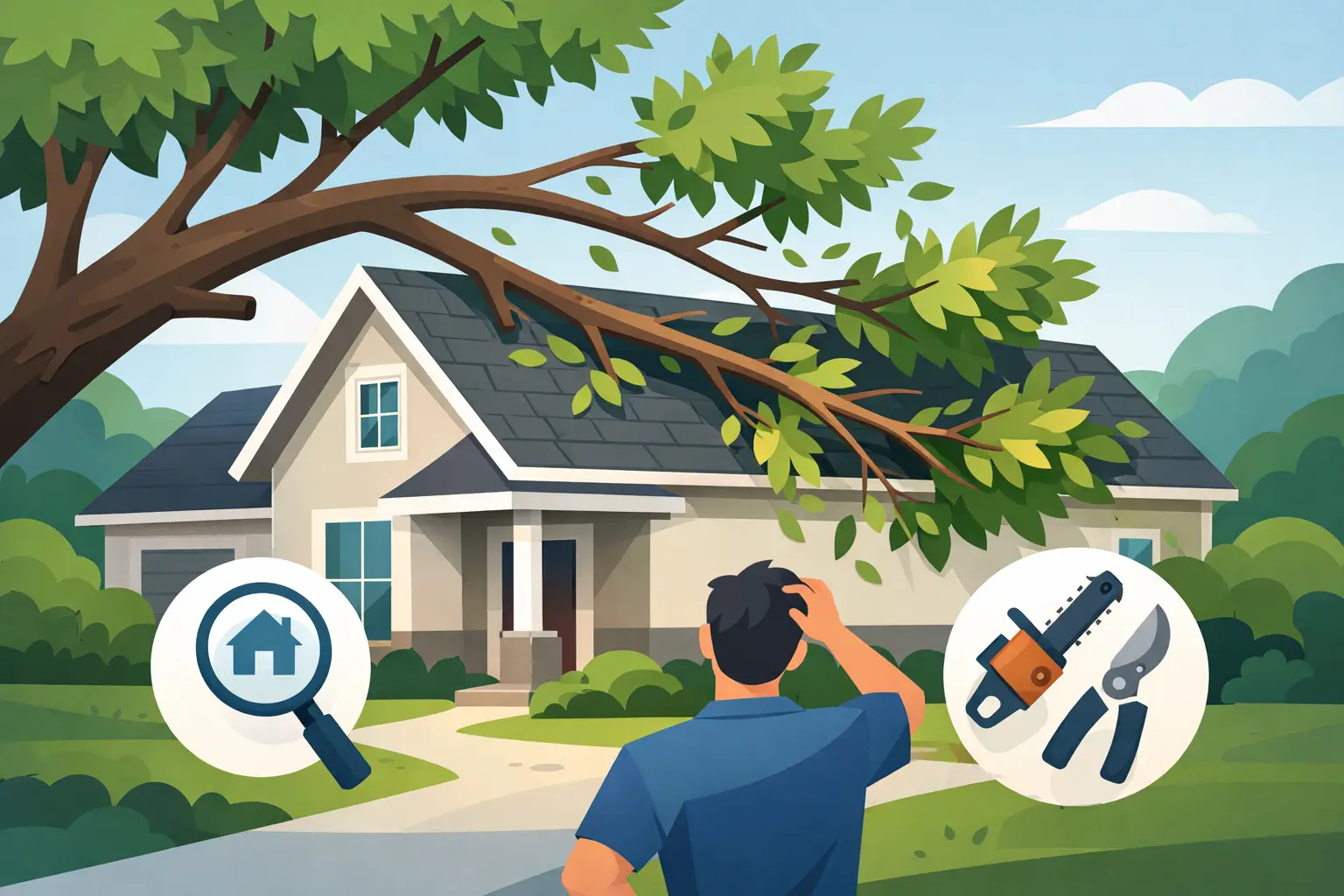
When you notice branches over house lines, shingles, or gutters, the problem usually looks smaller from the ground than it really is. A limb that seems harmless on a calm day can scrape roofing, drop debris into gutters, or fail during a Minnesota storm. If tree limbs are hanging over your home, the right move depends on the branch size, the tree species, the distance from the roof, and the tree’s overall condition.
Why branches over house become a real risk
A branch does not need to fall completely to cause damage. Repeated contact is enough to wear away shingles, damage flashing, and leave granules in the gutter. In winter, snow and ice add weight. In summer, heavy leaf growth catches wind. Both seasons can turn an overhanging limb into a roof problem.
There is also the issue you cannot always see from the driveway. A limb may look green and alive but still have a weak attachment point, internal decay, or a crack where it joins the trunk. When that branch is positioned over a house, the margin for error gets small.
For homeowners and property managers in Plymouth, Minnetonka, Maple Grove, and nearby West Metro communities, this is often less about tree appearance and more about preventing expensive repairs. Roof damage, broken gutters, siding impact, and blocked access after a storm all start with a branch that stayed in place too long.
Signs the branches over house need attention now
Some situations can wait for scheduled maintenance. Others should be addressed quickly. If a branch is already touching the roof, that is a clear sign it needs attention. The same goes for limbs hanging low over the structure, especially if they are large enough to damage decking or framing if they fail.
Watch for dead wood, visible cracks, split unions, hollow-looking sections, or bark peeling away. If the branch has shifted after a storm, or if you see fresh scraping marks on shingles, siding, or gutters, the tree is already affecting the house.
Trees that lean toward the home deserve a closer look too. Sometimes the issue is not just one branch. It may be a larger structural problem that makes trimming a short-term fix instead of the right long-term answer.
Common trouble spots homeowners miss
A lot of overhanging limbs cause damage without hitting the middle of the roof. They catch the roof edge, rub against fascia, or drop debris into valleys where water backs up. Limbs near chimneys and around upper-story corners also tend to go unnoticed until there is visible wear.
Another common issue is clearance over garages. Homeowners often focus on the main roof and forget that a branch over the garage can still damage shingles, dent gutters, and create a hazard over the driveway.
Trim or remove? It depends on the tree
Not every tree with branches over house areas needs to come down. In many cases, selective pruning is enough to restore safe clearance and reduce weight on overextended limbs. A good trim can also improve structure, reduce wind load, and keep branches from growing right back into the same problem zone.
But trimming is not always the best answer. If the tree is in poor health, has major decay, or has multiple large limbs over the structure, repeated pruning may only delay a larger failure. In those cases, removal can be the safer and more cost-effective option.
This is where experience matters. Cutting back too much at once can stress the tree and create a different problem. Cutting the wrong limbs can shift weight in an unsafe way. The goal is not just to get branches away from the house today. It is to leave the tree in a stable condition after the work is done.
When removal makes more sense
Removal is often the better option when a tree has significant dieback, trunk damage, root issues, or a history of storm failure. It can also make sense when the canopy is too close to the home to maintain safely through routine pruning.
For property managers, the decision usually comes down to ongoing liability and maintenance cost. If one tree keeps threatening a roof, parking area, or walkway, repeated trims may not be the smartest use of budget.
Why this is not a good DIY job
Homeowners are often comfortable trimming low branches in the yard. Branches over a house are different. The work is done over a structure, often near roofing, windows, service lines, fences, or landscaped beds. One wrong cut can send a limb into the home or cause a worker to lose control of the section being removed.
Ladders also create a false sense of security in this kind of work. The branch may look reachable, but the cutting angle, branch tension, and limited footing make it risky fast. Even smaller limbs can swing, twist, or kick back when cut.
Professional tree crews plan the removal path before the saw starts. They consider rigging, drop zones, roof protection, and cleanup. That matters when the job is above living space, a driveway, or a neighbor-facing lot line.
What a professional assessment should cover
A proper assessment is not just someone looking up and saying the branch should be cut. The crew should evaluate the species, branch size, growth pattern, attachment strength, and overall tree condition. They should also look at access, nearby structures, and how to protect the property during the work.
If the tree is worth keeping, the focus should be on targeted pruning that creates clearance without over-thinning the canopy. If the tree is declining or structurally unsound, the recommendation may shift toward removal.
Good communication is part of the process. Homeowners should know what will be cut, how the crew will protect the home and yard, and what cleanup will look like afterward. That removes a lot of uncertainty before the work begins.
Seasonal timing in Minnesota matters
In the West Metro, timing can affect both urgency and the type of work performed. Winter snow load and ice can make overhanging limbs more dangerous, especially on mature trees with broad lateral branches. Spring storms bring wind and saturated soil. Summer growth can push limbs closer to the roofline. Fall is often when homeowners finally notice just how much canopy has spread over the house.
There is no single perfect season for every job. Hazard reduction should not wait just because it is not ideal pruning season. If a limb is threatening the structure, safety comes first.
At the same time, some non-urgent pruning can be scheduled to fit the species and the property’s needs. That is another reason a site-specific estimate is worth getting instead of guessing.
Protecting more than just the roof
When people think about branches over house areas, they usually picture shingles. The real risk is broader than that. Overhanging limbs can damage gutters, siding, soffits, skylights, fences, decks, and air conditioning units below. They also drop leaves, twigs, and seeds that create cleanup issues and drainage problems.
In storm conditions, broken limbs can block driveways and access points. For rental properties or multi-unit sites, that becomes a tenant safety and access issue as much as a tree issue.
That is why the job should include property protection and thorough cleanup, not just cutting. The work is only done right when the hazard is removed and the site is left usable again.
When to call for help
If you have branches touching the roof, hanging low over the home, or showing signs of cracking, dead wood, or storm damage, it is time to have them looked at. Waiting usually does not make the job smaller or cheaper.
A straightforward estimate can tell you whether the tree needs pruning, reduction, or full removal. For homeowners in the Plymouth area, a crew like Xtreme Tree Service MN should be able to explain the options clearly, perform the work safely, and leave the property clean when finished.
The best time to deal with overhanging limbs is before the next heavy wind, not after it puts a hole in the roof. A quick look now can save a much bigger repair later.