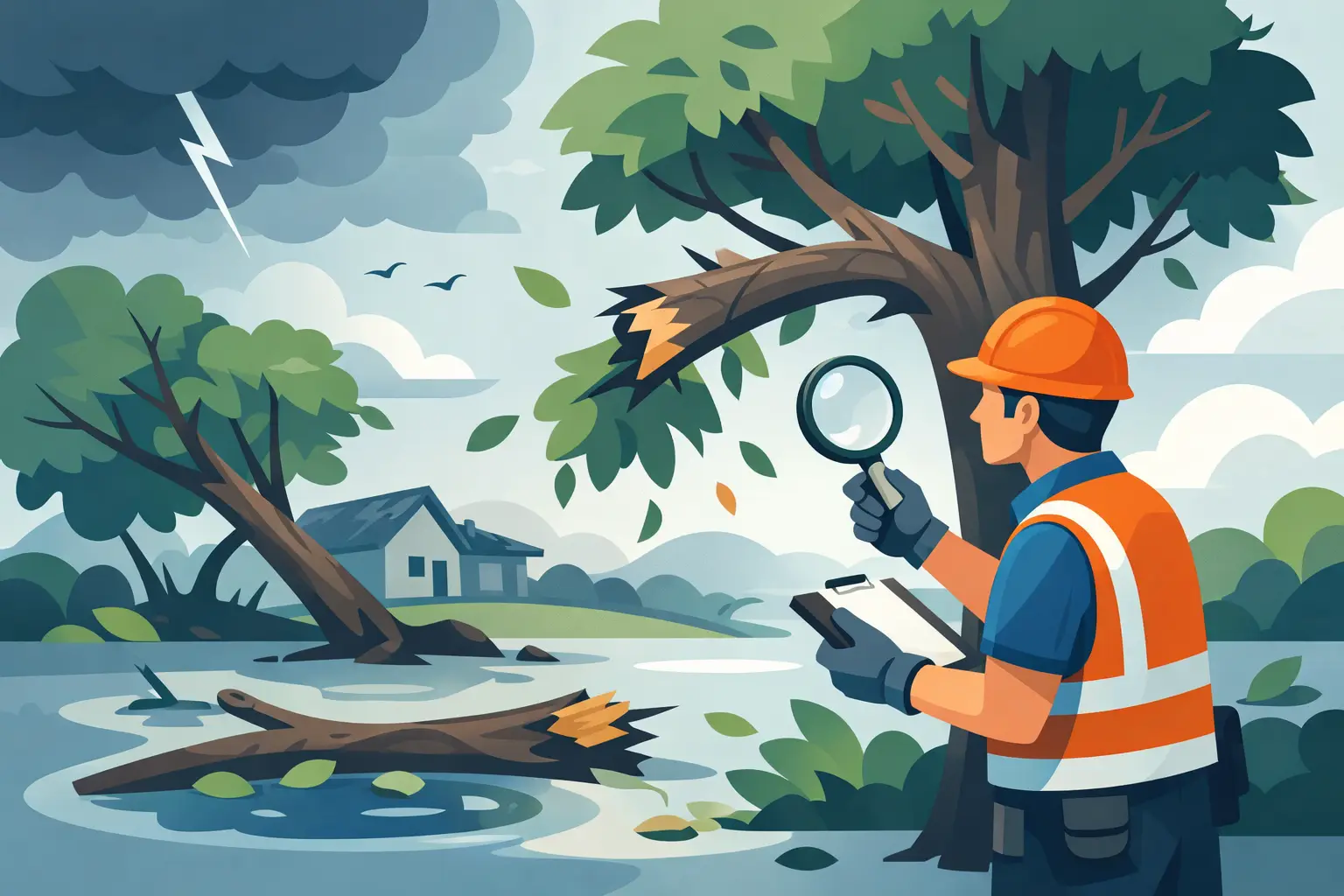
A storm can leave a yard looking worse than it is – or make a tree look fine when it is anything but. A branch may be hanging high in the canopy, roots may have shifted below the soil, or a cracked trunk may be holding together only until the next wind gust. Knowing how to inspect storm damaged trees from a safe distance helps homeowners and property managers make the right call before a small concern becomes a serious property hazard.
For Plymouth, Minnetonka, Maple Grove, and the rest of the West Metro, wind, heavy wet snow, ice, and saturated ground can all damage trees in different ways. The goal after a storm is not to fix everything yourself. It is to identify immediate risks, keep people clear, document what happened, and bring in experienced help when the damage is beyond safe ground-level cleanup.
Start With Safety, Not Cleanup
Before walking the property, wait until the storm has fully passed. Stay indoors if there is lightning, strong wind, or active icing. When it is safe to go outside, wear sturdy shoes and look from a distance first. Do not stand under broken limbs, lean against a damaged trunk, or walk beneath a canopy that has lost large branches.
Power lines change the situation immediately. If a tree, limb, or even a loose branch is touching or close to a utility line, stay well away and contact the utility company. Treat all lines as live. Do not attempt to move branches, use a pole saw, or pull anything free. A line can be energized even if it is lying on the ground or appears damaged.
Keep children, pets, tenants, and visitors out of the area until hazards are addressed. If a fallen tree blocks a driveway, sidewalk, or entrance, create a safe route around it rather than climbing over or under it. Storm cleanup often creates rushed decisions. Taking a few minutes to set boundaries around the work area can prevent an injury.
How to Inspect Storm Damaged Trees From the Ground
Walk the property slowly and look at each tree from several angles. You are looking for changes from the way the tree stood before the storm. Take photos from a safe distance, especially if damage is near a roof, fence, parked vehicle, or neighboring property. Pictures help document the condition and make it easier to explain the situation when requesting an estimate.
Start at the ground and work your eyes upward. Look for fresh soil cracks, raised ground on one side of the trunk, exposed roots, or a root plate that appears to be lifting. These are signs that a tree may be partially uprooted. A tree can remain standing after roots have failed, particularly in wet soil, but it may be unstable and ready to fall with little warning.
Then inspect the trunk. Long vertical cracks, fresh splits, missing bark, deep wounds, or a new lean deserve attention. A split trunk is especially concerning when the crack extends through a major fork where large stems join. Trees with multiple stems can fail at these weak unions during snow or wind events, even if much of the canopy remains intact.
Finally, look into the canopy without standing below it. Broken branch ends, limbs caught in other limbs, and branches hanging by strips of bark are all hazards. Arborists often call these hangers or widowmakers because they can fall later without warning. A branch that is only a few inches wide can cause damage or injury when it drops from height. A large limb is never a DIY project when it is suspended over a house, driveway, deck, or walkway.
Signs That Need Prompt Professional Attention
Some damage should move to the top of the list. Call for professional tree service promptly if you see a tree leaning toward a building or heavily used area; roots lifting or soil cracking around the base; a split trunk; large broken limbs lodged overhead; damage near electrical service; or a tree resting on a roof, garage, fence, or vehicle.
The same applies to trees that have lost a major leader, which is the main upright stem. Removing a large section of canopy changes the tree’s balance and may expose defects that were not visible before the storm. What remains may still be salvageable through careful pruning, but that decision depends on the species, age, structure, location, and extent of damage.
Check the Areas a Tree Can Reach
A damaged tree does not have to be fully down to cause trouble. Consider its fall zone and the paths beneath it. Look at roofs, gutters, decks, play areas, sidewalks, parking spaces, neighboring yards, sheds, and fences. For property managers, check common entrances, dumpster areas, tenant parking, and maintenance routes before allowing normal use.
Also inspect nearby trees. A fallen limb may have knocked into a second tree, cracked a branch union, or left debris caught in the canopy. Storm damage often comes in layers. Clearing the obvious tree from a driveway does not automatically mean the yard is safe.
If a branch is resting on a structure, do not pull it down with a truck, rope, or chain. That can cause more damage to the roof or siding, and the limb may shift unpredictably. Professional crews use controlled cutting and rigging methods when needed to remove weight in sections while protecting the structure below.
What Homeowners Can Handle and What They Should Not
There is a place for basic cleanup after a storm. Small twigs, leaves, and loose debris on open ground can usually be gathered once the area is clear. If a small branch is completely on the ground, away from power lines and not supporting any other limb, it may be reasonable to move it by hand.
The line changes when a task involves a ladder, chainsaw, overhead branch, tensioned wood, or a tree near a structure. Storm-damaged wood can be twisted, bent, or compressed under pressure. A cut that seems straightforward may cause a log or limb to roll, spring back, or drop unexpectedly. Ladders and chainsaws are a particularly dangerous combination, especially on wet ground.
Avoid topping a damaged tree or cutting random branches to make it look balanced. Improper cuts can leave large wounds, encourage weak regrowth, and make the tree more prone to future failure. In some cases, selective pruning can reduce weight and preserve a tree. In others, removal is the safer long-term choice. A professional assessment gives you a clear recommendation based on the actual condition of the tree, not just how it looks from the yard.
Give Damaged Trees Time for a Second Look
Not all storm damage is obvious on the first day. Once immediate hazards are handled, inspect the property again after a few days and after the next period of wind or rain. Watch for new drooping branches, cracks that widen, mushrooms near the base, bark peeling away, or a tree that develops a lean.
Evergreens deserve a close look after heavy snow and ice. Their limbs may remain bent for a while and sometimes recover as the weight melts away. Do not shake snow or ice from high branches, and do not try to straighten limbs with ropes. If major limbs are cracked or permanently bent into a hazardous position, a tree professional can determine whether careful pruning will help or whether removal is necessary.
Deciduous trees can hide damage when leaves are down, while summer storms may make a full canopy catch more wind. There is no one rule for every tree. A mature oak with one damaged limb may have years of useful life left. A smaller ornamental tree with a split trunk near the home may be a better candidate for removal. Location and structural condition matter as much as the size of the branch that broke.
Plan for Safer Future Storms
Storm response is easier when trees are maintained before severe weather arrives. Routine pruning removes dead, weak, rubbing, and overextended limbs before wind or snow puts them to the test. It can also improve clearance from roofs, driveways, service lines, and neighboring structures.
Pruning is not about stripping out a canopy or cutting every branch back. Over-pruning can weaken a tree and trigger fast, poorly attached growth. The right approach depends on the species, its condition, and what the tree needs to safely coexist with the property. For trees with visible decay, repeated limb failure, or poor structure, removal may provide more certainty than continued patchwork pruning.
When you request an estimate, share what changed after the storm and point out any concerns about access, structures, landscaping, or underground features. Clear communication helps the crew plan safer work and protect the areas that matter most. Xtreme Tree Service MN can assess storm-damaged trees, provide a straightforward recommendation, and handle removal, trimming, hauling, and cleanup when the job calls for professional equipment.
A storm-damaged tree rarely improves because it is ignored. If something looks shifted, cracked, hung up, or too close to your home, trust that concern and have it checked before the next round of weather makes the decision for you.