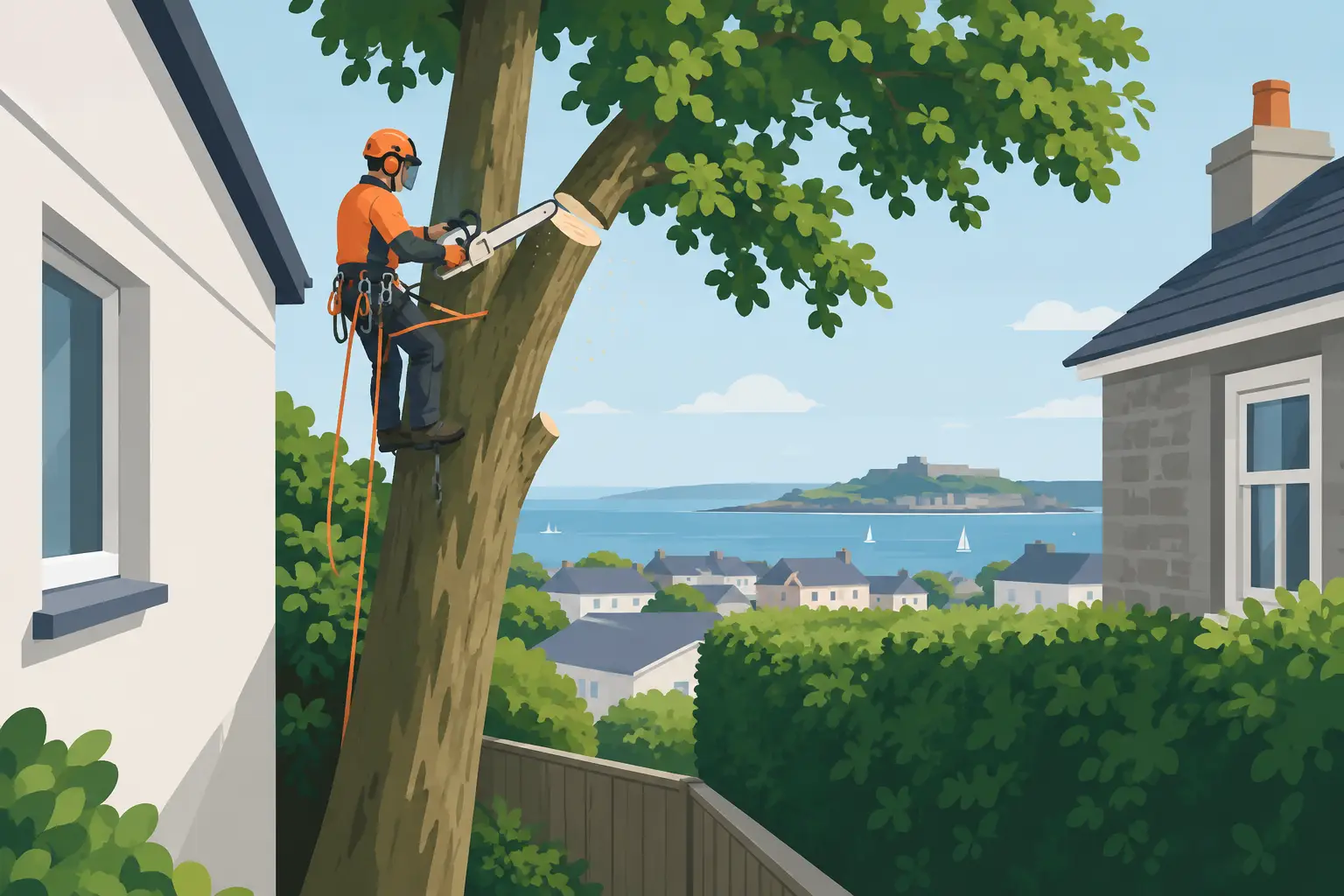
A mature tree can become a major problem when it is wedged between a house, fence, garage, and neighboring yard. This tight access tree removal case study reflects the kind of planning needed when there is no safe room to simply drop a tree. In Plymouth and across the West Metro, many established neighborhoods have exactly this challenge: large trees, small side yards, close property lines, and landscaping homeowners want to keep intact.
The job was not about removing a tree as quickly as possible. It was about taking it down in controlled sections, protecting the property below, and leaving the site clean when the work was done.
The Property Challenge
The tree stood in a narrow backyard corridor. A home was on one side, a detached garage was nearby, and a fence limited access from the other direction. The canopy reached over the roofline and extended toward a neighboring property. Below it were garden beds, a patio edge, and turf that the homeowner did not want torn up by heavy equipment.
The tree had declined enough that removal was the practical choice. Waiting increased the chance of branch failure, especially during high winds or heavy snow. But the limited space changed the removal plan completely. There was no open landing zone for large limbs, no clear route for a bucket truck, and no room to bring in oversized equipment without damaging the yard.
This is where experience matters. A tree that looks manageable from the street can require a very different approach once the crew sees roof angles, overhead limbs, access gates, fence lines, and the condition of the wood.
Tight Access Tree Removal Case Study: The Plan
Before any cutting started, the crew assessed the tree from the ground and identified where each section could safely travel. The key question was not just, “Can this limb be cut?” It was, “Where will it go after it is cut, and what is below it?”
The plan called for a climber to dismantle the tree from the top down. Smaller brush could be lowered or directed into the available work area. Larger limbs and trunk sections needed controlled rigging so they could be lowered slowly rather than dropped. Ropes, friction devices, and careful communication between the climber and ground crew made that possible.
The crew also established a protected work zone. Patio furniture and movable items were cleared from the area. Ground protection was placed where equipment and debris would travel. The homeowner understood which areas needed to remain clear while the work was underway.
A clear plan does not mean every cut is decided before the first rope is set. Tree work requires adjustments. Hidden decay, shifting wind, a limb under unexpected tension, or a weakened union can change the safest next step. The crew reviews those conditions as the tree comes down and works at a pace that keeps control in place.
Why Free-Dropping Was Not an Option
On an open lot, a crew may be able to fell a tree in one direction if there is enough clear space and the tree’s condition allows it. That was not the case here. A single uncontrolled section could have damaged a roof, fence, patio, or neighboring property.
Controlled lowering takes more time than simply cutting and dropping material. It also reduces risk where the cost of one mistake is far greater than the extra time spent rigging. For a tight-access removal, that trade-off is usually the right one.
Safe Removal, One Section at a Time
The removal started at the outer canopy. The climber reduced the smaller branches first, creating space to work and reducing the tree’s overall weight. Each branch was either lowered by rope or placed into the planned drop zone, depending on its size, reach, and what was beneath it.
Once the canopy was cleared, the crew worked down the main stems in manageable sections. Larger wood was attached to a rigging line before it was cut. The ground crew took the load, guided it away from the house and fence, and lowered it into the work area. This process continued until the remaining trunk was short enough to remove safely.
Communication was constant. The climber called each move before making a cut. The ground crew confirmed the rope was ready, the landing area was clear, and everyone was out of the drop zone. This is basic field discipline, but it makes a real difference on a confined job site.
The work also required attention to the homeowner’s landscaping. Not every branch can avoid the lawn completely, and some temporary wear can happen during a large removal. Still, the goal is to minimize impact. Using smaller access routes, staging debris carefully, and avoiding unnecessary machine traffic helps protect established yards.
What Homeowners Should Expect From a Tight-Access Job
A tight-access tree removal may cost more than removing the same tree from an open yard. The reason is straightforward: there is more labor, more rigging, more time, and often more hand handling of brush and wood. A crew may need to carry material through a side gate instead of moving it directly with equipment.
That does not mean every confined backyard requires the same method. Some properties have enough access for a compact loader. Others can safely use a small drop zone. A tree near utility lines may require a different approach, and a tree with major decay may need extra caution during climbing. The right plan depends on the tree, the property layout, and the hazards around it.
Homeowners can help the process go smoothly by providing access to gates, moving vehicles from the driveway, securing pets, and pointing out irrigation heads, buried lines, or other features the crew should avoid. If a neighbor’s yard may be affected by the work area, a quick conversation ahead of time can prevent surprises on removal day.
Cleanup Is Part of the Job
After the final trunk section was down, the work shifted to cleanup. Brush was chipped or loaded for hauling. Logs were removed or handled according to the agreed plan. The crew raked the work area, collected smaller debris, and checked the driveway, sidewalk, and street for sawdust and twigs.
For many homeowners, cleanup is what turns a difficult tree project into a finished job. A removed tree should not leave a yard full of branches, scattered wood, and unanswered questions about what happens next.
If the stump remains, stump grinding can be scheduled to remove it below grade. This is often a good option when the homeowner wants to reclaim the space for grass, a garden bed, or future landscaping. It depends on the location, the root system, and the plans for the area.
The Result: A Safer Yard Without Unnecessary Damage
The result of this type of removal is not just an empty space where a tree once stood. It is a safer property, a protected home and fence line, and a job site that is ready for the homeowner to use again.
At Xtreme Tree Service MN, tight-access work starts with a close look at the property, not a one-size-fits-all answer. A fast, no-pressure estimate gives homeowners and property managers a chance to understand the plan, ask questions, and make a decision without guessing.
If a tree is growing too close to your home, leaning over a structure, or declining in a narrow part of the yard, do not wait for a storm to test it. A careful assessment now can give you a clear path forward and help protect the property you have worked hard to maintain.