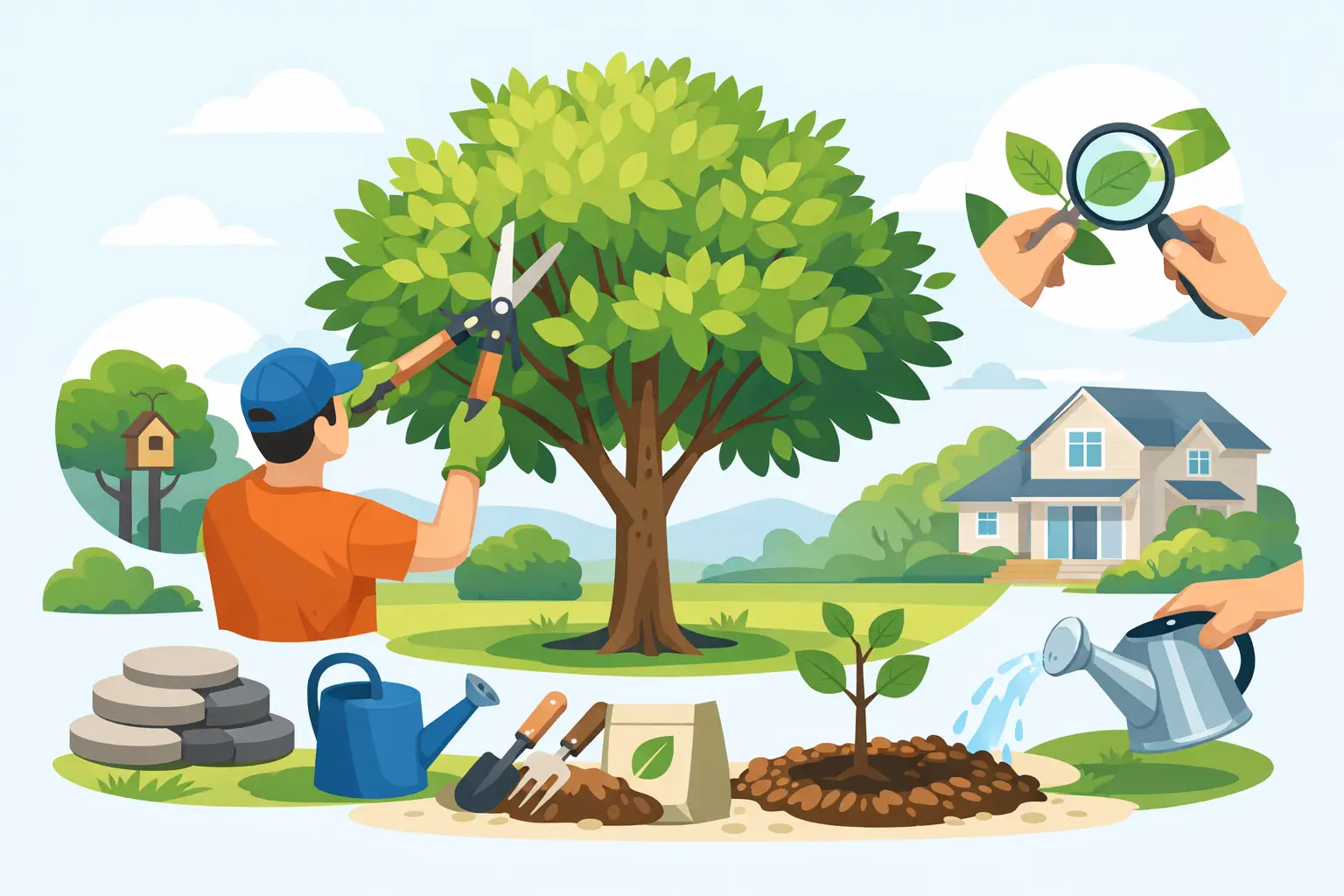
A mature tree can add shade, privacy, and real value to a Plymouth-area property. It can also become a costly safety issue when dead limbs, weak branch unions, root damage, or storm stress go unnoticed. These best tree care tips for homeowners focus on the practical work that prevents avoidable damage while helping healthy trees stay strong.
1. Inspect trees after major weather changes
Minnesota trees take a beating from heavy snow, ice, high winds, saturated soil, and summer storms. A quick walk around the yard after rough weather can catch problems before the next storm makes them worse.
Look up for hanging limbs, fresh cracks, split trunks, and branches resting on a roof, fence, or utility line. At ground level, watch for new leaning, lifted soil around the base, exposed roots, mushrooms at the trunk, or a sudden loss of bark. None of these signs automatically means a tree has to come down, but they do warrant a professional assessment.
Keep people, pets, and vehicles out from under a damaged canopy. A branch that is caught in another branch or touching a power line is not a homeowner repair. Call the utility company for electrical hazards, and use a qualified tree crew for the tree work.
2. Prune with a purpose, not just for appearance
Pruning is one of the most useful forms of tree care, but poor cuts can create decay, weak regrowth, and long-term structural problems. The goal is not to make a tree smaller at all costs. It is to remove dead, damaged, rubbing, or poorly placed branches while preserving the tree’s natural shape.
For many deciduous trees, late winter is a good time for planned pruning because the branch structure is easier to see and crews are not working around full foliage. However, timing depends on the species and the reason for the work. Oak trees deserve special care in Minnesota because pruning during higher-risk periods can contribute to oak wilt spread. Storm-damaged limbs should be addressed when safety requires it, regardless of season.
Avoid topping – cutting major branches back to blunt stubs. It may make a tree look shorter for a short time, but it often leads to weak, fast-growing shoots and larger hazards later. If a tree has outgrown its location, selective reduction or removal may be the safer choice.
3. Keep mulch off the trunk
Mulch helps conserve soil moisture, moderate temperature swings, and reduce competition from grass. It works best when it is used correctly. A two- to three-inch layer spread in a wide ring around the tree is usually enough for established landscape trees.
Do not pile mulch against the trunk. The familiar “mulch volcano” holds moisture against bark, encourages decay, and can lead to surface roots that circle the trunk. Pull mulch back several inches so the root flare – where the trunk begins to widen at the base – remains visible.
Freshly planted trees benefit most from a broad mulch ring. Established trees can benefit as well, especially where lawn equipment and compacted turf compete with roots.
4. Water deeply during dry stretches
A green lawn can hide dry soil below the surface. Trees need deep moisture around their root zone, not a quick daily splash at the trunk. This is especially true for newly planted trees, which have limited roots outside their original root ball.
During extended dry periods, water slowly enough for moisture to soak into the soil rather than run across the lawn. Focus on the area beneath and slightly beyond the canopy edge, where many feeder roots grow. The right schedule depends on soil type, tree species, recent rainfall, and tree age. Clay-heavy soil common in parts of the West Metro holds water longer than sandy soil, so overwatering can be as harmful as underwatering.
Watch the tree rather than relying only on a calendar. Wilting, early leaf drop, scorched leaf edges, and unusually small leaves can signal drought stress. If you are unsure whether the soil is dry below the surface, check before adding more water.
5. Protect the root zone from damage
Most tree roots are much closer to the surface than homeowners expect. Cutting, compacting, filling over, or repeatedly driving across the root zone can weaken a tree even when the canopy still looks healthy. Damage may not show up for months or years.
Before adding a patio, driveway, retaining wall, shed, or new landscaping, consider the nearby trees early in the planning process. Construction equipment, changes in grade, and trenching for utilities can all affect roots. A tree professional can help identify where protection measures are needed and whether a tree is likely to tolerate the project.
Even routine yard work matters. Keep mowers and string trimmers away from the trunk. Repeated wounds at the base can damage the tree’s protective tissue and invite insects or disease.
6. Learn the difference between normal change and a warning sign
Trees drop leaves, shed small twigs, and develop minor deadwood as they age. Those changes are normal. What deserves closer attention is a sudden or uneven change.
Call for an assessment if one side of the canopy leafs out poorly, a formerly healthy tree loses leaves early, large limbs die without an obvious reason, or the trunk develops a deep crack or cavity. Also pay attention to included bark, which occurs when two stems grow tightly together with bark trapped between them. These unions can split under snow or wind loads.
A tree near a house, driveway, sidewalk, play area, or neighboring property deserves a more cautious standard than a similar tree at the back of a large lot. Risk is not only about whether a tree might fail. It is also about what it could hit.
7. Do not treat every insect or fungus the same way
Finding insects, leaf spots, or mushrooms does not always mean a tree is dying. Many pests are temporary, cosmetic, or part of the normal ecosystem. Unnecessary treatments cost money and can affect beneficial insects.
At the same time, some issues move quickly or point to a bigger problem. Signs such as bore holes with sawdust-like material, extensive canopy thinning, peeling bark, or mushrooms growing at the base should not be ignored. Take clear photos and note when you first saw the change. That information helps a qualified professional narrow down what is happening.
The best approach depends on the species, the condition of the tree, and the location. Sometimes pruning out affected material is enough. Sometimes treatment, monitoring, or removal is the responsible option.
8. Plan ahead for storm season
You cannot prevent every storm failure, but you can reduce the chance of surprise damage. Remove dead limbs before they fall. Have overextended branches inspected if they reach over a roof, garage, driveway, or neighbor’s yard. Clear weak volunteer trees from fence lines and crowded areas before they become larger removal projects.
Do not wait until a branch is resting on your roof to decide who will handle the work. Keep a reliable local tree service contact available, especially if your property has large mature trees. After a storm, document damage from a safe distance and avoid walking beneath broken or suspended limbs.
9. Know when DIY work stops being safe
Homeowners can often handle light cleanup, watering, mulch, and pruning of small branches from the ground. The job changes once a ladder, chainsaw, power line, roofline, heavy limb, or leaning tree is involved.
Tree work is unpredictable because wood can shift, roll, pinch a saw, or fall in a direction that was not expected. A professional crew has the equipment, rigging knowledge, and job-site process to control the work and protect nearby structures. That matters even more in tight suburban yards where homes, landscaping, fences, and neighboring properties are close together.
10. Address stumps and cleanup as part of the plan
After a tree is removed, the remaining stump can become a mowing obstacle, attract pests, and limit how you use the yard. Stump grinding is usually the practical solution when you want to restore the area for grass, planting, or a future landscape project. The depth and cleanup needs depend on what will go in that spot next.
Ask clear questions before any major tree job begins: What is being removed or pruned? How will the crew protect turf and nearby structures? What happens to logs, brush, and wood chips? A dependable contractor should set expectations before work starts and leave the property clean when the job is finished.
Healthy trees are worth protecting, and hazardous trees are worth addressing before they force an emergency decision. If something in your yard does not look right, trust that first observation, keep the area clear, and have it checked while there is still time to choose the safest next step.