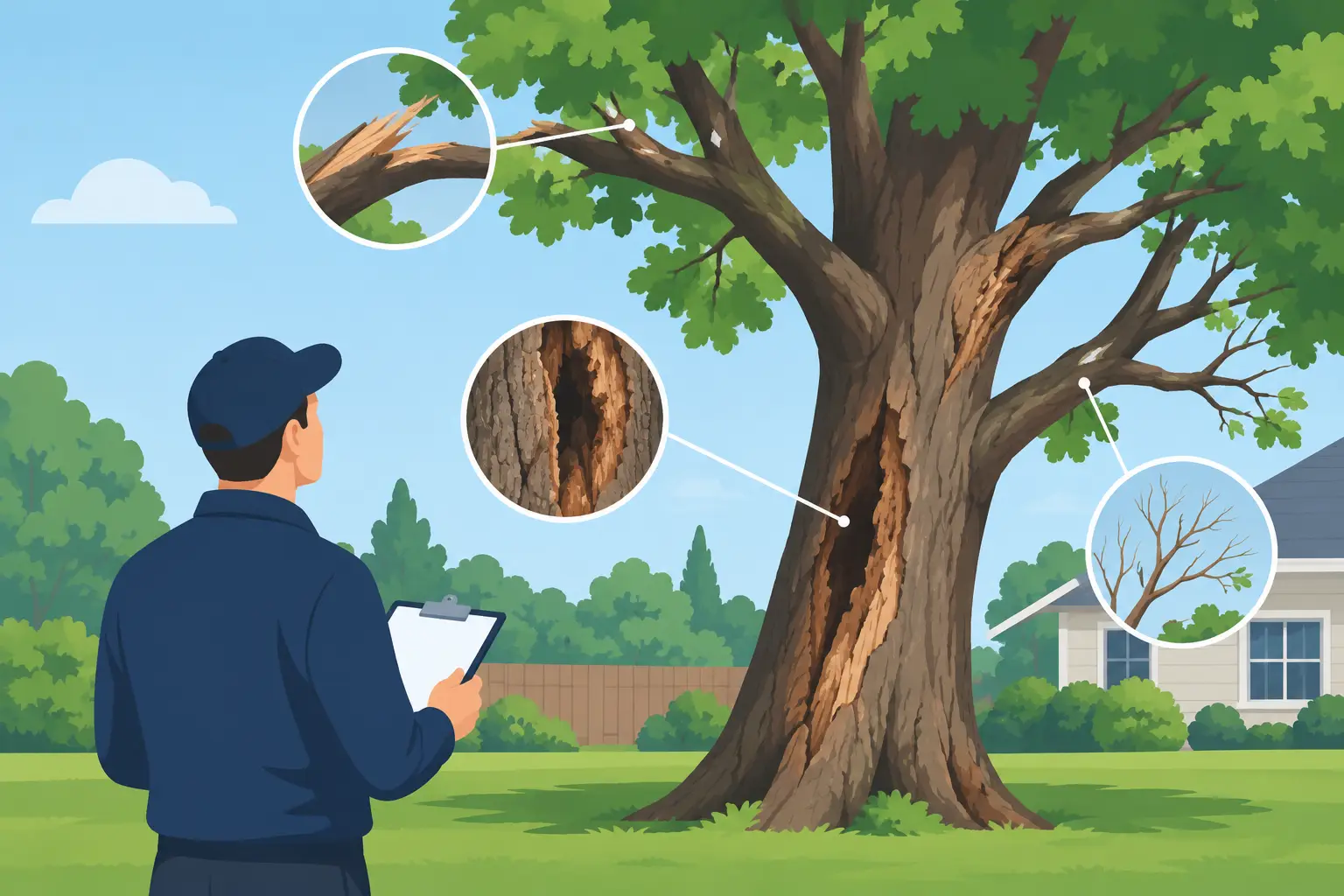
A tree can look healthy from the sidewalk and still pose a real risk to your home, vehicles, neighbors, or tenants. Knowing how to identify dangerous trees gives you time to act before high winds, heavy snow, or a saturated spring lawn turn a weak tree into an emergency.
For Plymouth, Minnetonka, Maple Grove, and the rest of the West Metro, the biggest concern is usually not a tree that looks obviously dead. It is the leaning trunk, hidden decay, hanging limb, or compromised root system that fails when weather adds pressure. A quick visual check from the ground can help you spot trouble early, but some signs call for a trained tree professional right away.
How to Identify Dangerous Trees Before They Fail
Start by looking at the whole tree, not just the canopy. Check the trunk, the branches, the ground around the base, and what sits within reach of the tree. A small dead limb over an open lawn may be a routine pruning issue. That same limb over a driveway, play area, roof, power line, or parking lot deserves more urgent attention.
Tree risk is rarely based on one sign alone. A mature tree with a slight natural lean may be stable for years. But a new lean combined with cracking soil, dead branches, or a split trunk is a different situation. Location, size, species, recent weather, and nearby targets all affect the level of risk.
Look for dead or dying branches
Dead branches are often the first warning homeowners notice. They may have no leaves during the growing season, brittle twigs, peeling bark, or a gray, lifeless appearance. Large dead branches in the upper canopy are sometimes called widowmakers because they can drop without warning.
Do not stand beneath a questionable limb to inspect it, and do not try to pull it down with a rope. Branches can shift, break unpredictably, or bring down other damaged limbs with them. If the branch is large or hangs over something valuable, professional pruning is the safer choice.
A tree with scattered dead limbs may still be treatable, depending on the cause. A tree with extensive dieback across the crown, especially after leaf-out, may be in serious decline and should be evaluated promptly.
Watch for cracks, splits, and weak branch unions
Cracks in a trunk or major limb are a clear reason to take the tree seriously. Some cracks are shallow bark splits caused by temperature changes, while others extend into the wood and signal structural failure. You cannot reliably judge crack depth from the ground, so avoid assuming a narrow-looking crack is harmless.
Also inspect where large limbs join the trunk. A strong branch union usually has a visible collar of overlapping wood. A weak union often forms a tight V shape, sometimes with bark trapped between the two stems. This is called included bark. As the stems grow larger, they can push apart and split under wind, snow, or ice load.
Multiple trunks growing from the same point deserve extra attention, particularly when the tree is mature and one stem leans away from the other. Pruning can sometimes reduce weight and improve the situation. In other cases, removal is the safer long-term decision.
Pay attention to a new or worsening lean
Many trees grow with a natural lean. The concern is a lean that appears suddenly or becomes more noticeable after a storm, construction project, or period of wet soil. A tree pulling away from vertical may have damaged roots or a failing root plate.
Look at the soil on the opposite side of the lean. Raised earth, exposed roots, fresh cracks in the ground, or a mound of soil lifting near the base are warning signs that the tree may be shifting. Keep people, pets, and vehicles away from the area until it can be assessed.
A leaning tree near a house is not automatically an emergency, but a recent lean near a structure should not wait for the next storm. Wind direction and soil conditions can change the risk quickly.
Check the Trunk for Decay and Damage
A sound trunk supports the entire tree. When decay, injury, or disease weakens that support, the tree can fail even if it still has green leaves.
Cavities, mushrooms, and soft wood can mean internal decay
Holes and cavities do not always mean a tree must come down, but they are worth a closer look. A small old wound may be contained by healthy wood. A large cavity at the base of the trunk, especially on a big tree near a target, can significantly reduce its strength.
Mushrooms or shelf-like fungi growing from the trunk, root flare, or nearby ground can also indicate decay in the roots or wood. The fungus itself is not the main danger. It is evidence that wood inside or below the tree may be breaking down.
Do not probe cavities with tools, climb the tree, or remove fungi to make the problem look better. The goal is to understand whether the tree still has enough sound wood to remain stable, not to cover up the warning sign.
Look for missing bark and fresh wounds
Damage from lawn equipment, vehicles, construction, or animals can create an entry point for decay and disease. Fresh wounds around the base are especially concerning because they can affect the living tissue that moves water and nutrients through the tree.
Construction is a common hidden cause of tree decline. Grade changes, trenching, compacted soil, driveway work, and root cuts can injure a tree without showing immediate symptoms. If a tree started thinning out or leaning after work was done nearby, mention that history during an inspection.
Inspect the Root Zone, Not Just the Canopy
Roots are out of sight, but they are often where serious problems begin. A tree may look full and green while root rot, storm damage, or soil disturbance is reducing its ability to stand.
Check for exposed, broken, or decaying roots near the trunk. Soil heaving, new depressions, and cracks around the root zone can point to movement below ground. Roots that have been cut during landscaping or utility work may leave the tree unstable on one side.
Minnesota’s freeze-thaw cycles and heavy rain can expose root issues that were not obvious during dry weather. After a major storm, walk the property from a safe distance and compare trees to how they looked before. New changes matter more than a long-standing feature.
Consider What the Tree Could Hit
A tree does not have to be likely to fail tomorrow to deserve attention. Risk rises when the consequences of failure are high. A declining tree at the back edge of a large lot may be less urgent than a smaller damaged tree over a bedroom, service line, sidewalk, or shared parking area.
Prioritize trees near these targets:
- Homes, garages, sheds, fences, and decks
- Driveways, sidewalks, play sets, patios, and outdoor seating areas
- Parked vehicles and frequently used access routes
- Neighboring properties and common areas
- Utility lines, service drops, and electrical equipment
If branches are touching or close to power lines, do not prune them yourself. Stay clear and contact the utility provider or a qualified tree service that can advise on the safe next step. Electricity can travel through limbs, equipment, and wet ground.
When to Call for Professional Tree Help
Call promptly if you see a cracked trunk, split leader, fresh lean, lifted root plate, major hanging branch, or a tree that has partially fallen and is resting on another tree. These conditions can change without warning, particularly during wind, rain, or snow.
For less urgent concerns, an on-site assessment can help you decide whether pruning, removal, cabling, or monitoring makes sense. There is no one-size-fits-all answer. Tree species, health, size, and placement all matter. A professional should explain the concern clearly and recommend work based on the actual condition of the tree, not pressure.
Avoid DIY removal when a tree is large, damaged, near structures, or entangled with other trees. Cutting the wrong limb can shift the load suddenly, and a partially cut tree is often more dangerous than the original problem. Safe tree work requires the right equipment, planned cuts, controlled lowering, and a clear work zone.
Xtreme Tree Service MN helps homeowners and property managers handle hazardous trees with safe removal, practical recommendations, and thorough cleanup. If something about a tree does not look right, taking a few clear photos from a safe distance and arranging an evaluation is a sensible next move before the weather makes the decision for you.
Leave a Reply