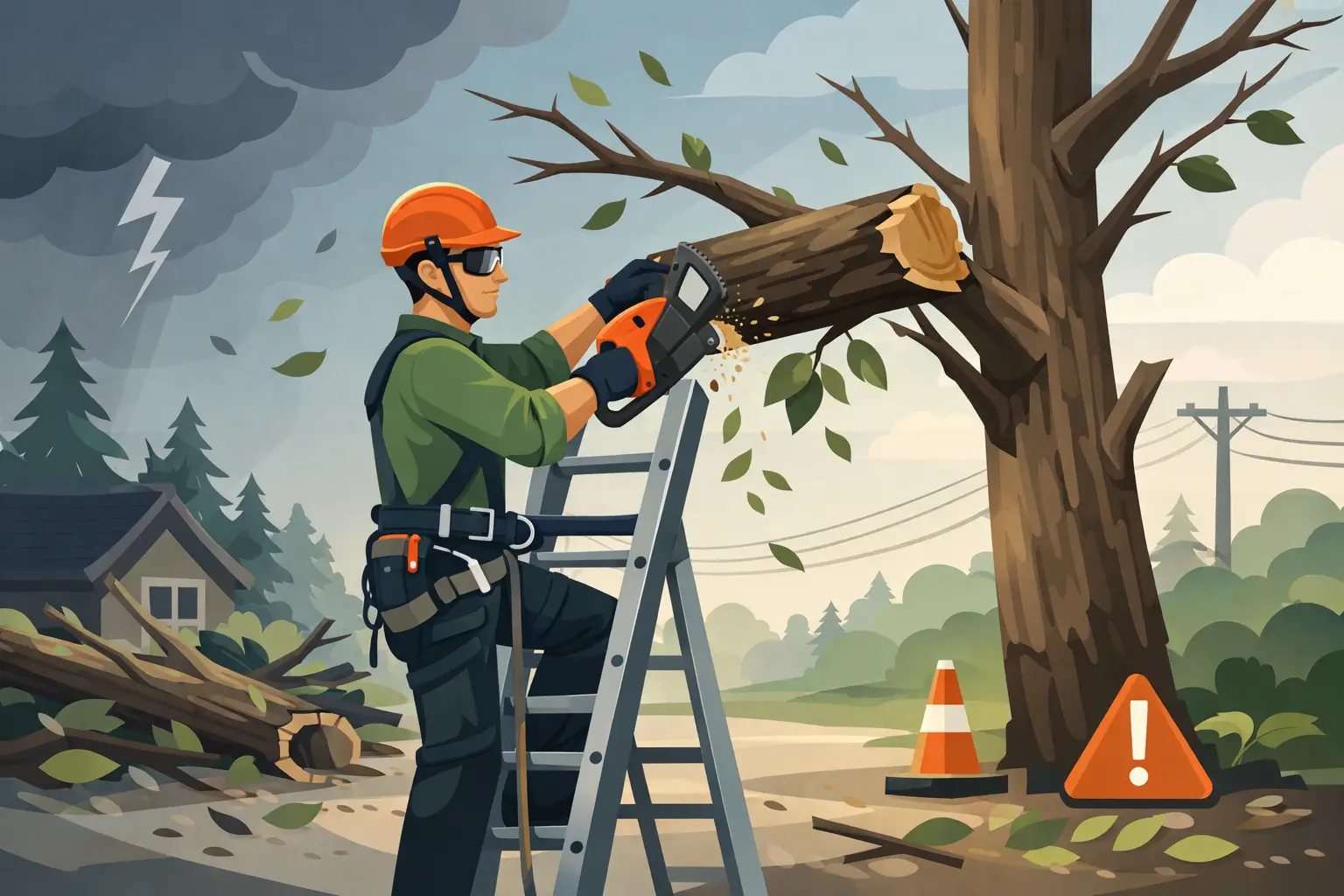
A branch can look harmless after a storm until you notice it is hanging over the driveway, resting on a fence, or caught in a nearby tree. Knowing how to remove storm branches starts with knowing when not to touch them. Wind, ice, and heavy snow can leave branches under tension, tangled in utility lines, or partially supported by damaged wood that can shift without warning.
For homeowners and property managers in Plymouth, Minnetonka, Maple Grove, and the West Metro, the first priority is simple: keep people, pets, vehicles, and buildings out of the danger area. Cleanup can wait a few hours. An injury, damaged roof, or downed power line is a much bigger problem.
Start With a Safe Storm Damage Check
Before moving any branch, walk the property from a safe distance. Do not stand beneath broken limbs or directly below a tree with a damaged canopy. Look up before walking under trees, especially after high winds or an ice storm. A branch that appears caught can fall when another limb moves, snow melts, or the wind picks up again.
Check for obvious damage to roofs, gutters, vehicles, fences, sheds, and landscaping. Take clear photos before cleanup if you may need them for insurance documentation. If a branch has landed on a structure, avoid pulling it off yourself. The weight may be holding damaged roofing, siding, or gutters in place. Removing it can make the damage worse.
Pay attention to the full tree, not just the branch on the ground. A split trunk, lifted roots, fresh cracks in major limbs, or a tree leaning farther than usual can indicate a larger failure risk. In that situation, leave the entire area alone and arrange for a professional assessment.
How to Remove Storm Branches That Are Already Down
Branches that are completely on the ground, well away from power lines and structures, are the safest type of storm debris for a homeowner to handle. Even then, work carefully. Wear sturdy boots, gloves, eye protection, and long sleeves. Storm debris often hides sharp wood, metal, glass, nails, and uneven ground beneath leaves or snow.
Start at the smaller outer limbs and work toward the thicker sections. Drag manageable brush into a clear pile away from sidewalks, driveways, and fire hydrants. Keep the pile low and organized rather than stacking branches high against a fence or garage. A low pile is easier to manage and less likely to shift.
Use hand pruners or a hand saw for small limbs that are lying flat and are not bent, pinned, or twisted. If a branch is under tension, it can spring when cut. That includes limbs trapped beneath another branch, caught under a fence panel, or bowed between two supports. Do not guess which direction the wood will move. Leave tensioned branches for an experienced tree crew with the right cutting plan and equipment.
A good rule is to stop when the job requires a ladder, a chainsaw above ground level, or cutting near a structure. Those are not small cleanup tasks anymore. They are tree-work hazards.
Keep Chainsaw Work Ground-Level and Limited
A chainsaw is useful only when the branch is stable, accessible from the ground, and within your comfort level. It is not a tool for reaching overhead, working from a ladder, or cutting a limb that is resting against a home. Never use a chainsaw while standing on a wet roof, icy driveway, unstable pile of brush, or elevated surface.
If you choose to cut a stable log section, make sure it cannot roll. Stand to the side of the cut rather than directly behind the saw. Keep other people well outside the work area, and stop if the chain binds, the wood starts moving, or you cannot maintain secure footing. There is no benefit to forcing a cut after a storm.
For most residential properties, hauling large storm branches is often more work than cutting them. Long limbs are awkward, heavy, and difficult to load safely. A professional crew can cut, chip, haul, and clean up the debris without leaving a pile at the curb for weeks.
Stay Away From Power Lines and Service Drops
Any branch touching, near, or hanging above an electrical line is a hands-off situation. Treat every line as energized, including the service line running from the utility pole to your home. Electricity can travel through wet wood, tools, ladders, fences, and the ground. A branch does not need to be visibly sparking to be dangerous.
Keep everyone back, especially children and pets. Do not attempt to move the branch with a pole, rope, rake, or pruning tool. Do not climb the tree, and do not use a ladder anywhere nearby. Contact the utility company for a downed or threatened power line. Once the line is made safe, a qualified tree service can address the tree debris.
This also applies when a branch is simply close to a line. Storm-damaged wood can drop or swing while being cut. Proper clearance, trained crews, and the right equipment matter here.
Branches Over a Roof, Driveway, or Fence Need More Care
A limb resting on a roof may look like it can be lifted away by a few people. The problem is that the branch may be cracked higher in the tree, caught under another limb, or carrying more weight than it appears. Pulling from below can bring down additional wood or scrape roofing materials.
The same concern applies to branches across a driveway or fence. If access is blocked, mark off the area and use another route when possible. A professional can remove the branch in controlled sections while protecting the surrounding property. This is especially worthwhile when the branch is large enough to require more than one person to move.
If a branch is suspended above a vehicle, do not move the vehicle until you know the limb is stable. A slight vibration from opening a door, starting the engine, or pulling forward can be enough to shift damaged wood. Photos and a prompt inspection can also help if vehicle or property damage needs to be documented.
Do Not Climb to Remove Hanging Branches
The most dangerous storm branches are often the ones still in the tree. They may be broken but held in place by bark, smaller branches, or a twisted section of wood. These are often called hangers or widowmakers because they can fall suddenly.
Do not climb a damaged tree or use a ladder to reach a hanging branch. Storm damage changes the structure of the tree. Limbs that once supported a ladder may be cracked, and the trunk itself may be unstable. Pole saws also have limits. They can be useful for routine ground-level pruning, but they are not a safe answer for a heavy overhead limb, a branch near a line, or a tree with widespread damage.
Professional removal crews use controlled cuts, ropes, rigging, aerial equipment, and site protection based on the branch, tree, and surrounding obstacles. The right method depends on whether the limb can be dropped safely, needs to be lowered in sections, or requires access from a bucket truck.
Know When to Call for Professional Storm Cleanup
Call a tree professional when a branch is hanging overhead, larger than you can safely move, caught under tension, near utility lines, or resting on a home, vehicle, fence, or outbuilding. It is also smart to call when a tree has split, shifted at the roots, lost a major leader, or has multiple broken limbs.
For property managers, prompt cleanup also reduces liability. A blocked walkway, unstable limb near a parking area, or damaged branch over a common space can create a hazard for tenants, visitors, and maintenance staff. Temporary barriers help, but removal should not be delayed when people regularly pass through the area.
Xtreme Tree Service MN handles storm-damaged branches with a safety-first approach, clear communication, and thorough cleanup. A proper assessment looks at the branch on the ground and the damage still left in the tree, so the immediate problem does not turn into another one after the next strong wind.
After the Branches Are Gone, Watch the Tree
Storm cleanup is not always the end of the job. Over the next few days, inspect the tree from the ground for new cracks, drooping limbs, loose bark, or sections that continue to sag. Some damage becomes more visible after snow melts or the canopy dries out.
A clean yard matters, but a stable tree matters more. When storm branches are beyond simple ground-level cleanup, keeping clear and calling for help is the practical choice that protects your property and the people around it.