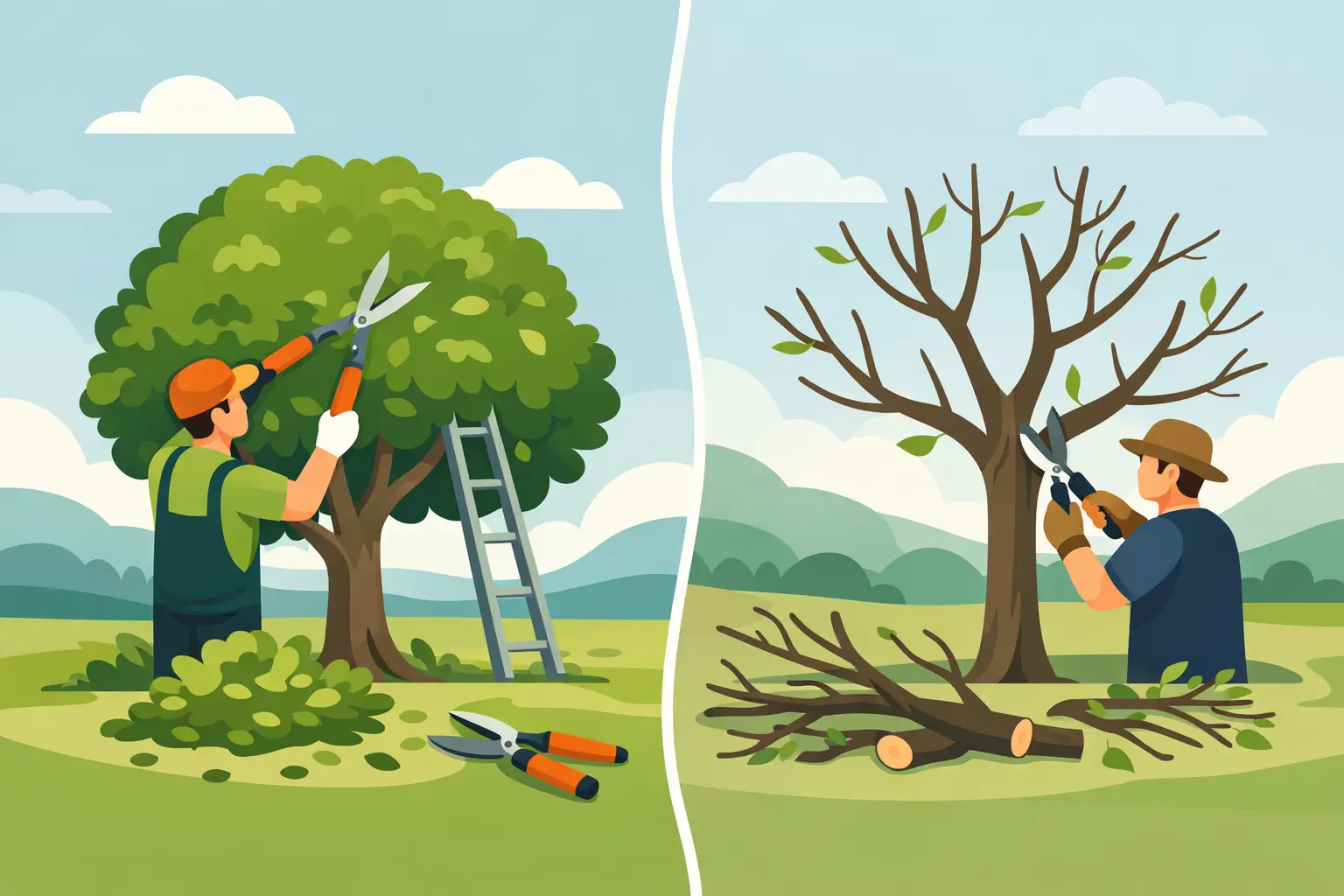
If you are asking what is the difference between tree trimming and tree pruning, the short answer is this: trimming is mainly about shape, appearance, and managing overgrowth, while pruning is done to improve tree health, structure, and safety. Homeowners often use the terms interchangeably, but in the field, the goal behind the cut matters.
That difference matters more than most people think. The wrong cut at the wrong time can weaken a tree, leave it vulnerable to disease, or create future storm problems near your roof, driveway, or power lines. When you understand what each service is meant to do, it is easier to make the right call for your property.
What is the difference between tree trimming and tree pruning?
Tree trimming usually focuses on controlling size and keeping a tree or shrub neat. It is often used for branches that are growing too far over a yard, crowding a house, blocking a walkway, or making the landscape look overgrown. The work is typically centered on appearance and clearance.
Tree pruning is more selective. It targets dead, damaged, diseased, weak, or poorly attached limbs to improve the tree’s overall condition and reduce risk. Pruning also helps guide healthy growth, especially in younger trees that need better structure as they mature.
In real jobs, the two services can overlap. A crew may trim back overextended limbs while also pruning deadwood or correcting structural issues. But the purpose of the work is what separates one from the other.
Tree trimming is usually about control and appearance
When a tree starts pushing branches over the driveway, rubbing against the house, or hanging too low over a patio, trimming is often the right service. It helps restore clearance and keeps the canopy from getting too dense or uneven.
For many residential properties in Plymouth, Minnetonka, and Maple Grove, trimming is part of routine maintenance. Fast-growing species can expand quickly, and a branch that seemed harmless two years ago can end up scraping shingles, shading out turf, or hanging over a parked car.
That does not mean trimming is just cosmetic. It can improve sightlines, keep access open, and reduce the chance of small limbs breaking during wind or heavy snow. But the main goal is still management of growth and shape rather than correcting a health problem inside the tree.
Common reasons a tree needs trimming
A tree may need trimming when branches are extending too close to the roofline, blocking windows, crowding neighboring trees, or throwing the canopy out of balance. Some property managers also schedule trimming to maintain a cleaner, more uniform appearance across the site.
There is a trade-off, though. Over-trimming can stress a tree, especially if too much live growth is removed at once. That is why careful cuts and a clear plan matter.
Tree pruning is focused on health and risk reduction
Pruning is the better term when the job is about removing specific problem limbs. Deadwood, storm-damaged branches, cracked unions, crossing limbs, and diseased sections are all common pruning targets.
This kind of work is important because a tree can look full and green from the ground while still having internal issues. A weak branch attachment or a decaying limb may not seem urgent until the next storm pushes it down onto a fence, garage, or vehicle.
Pruning can also help a tree develop better long-term structure. On younger trees, removing competing leaders or poorly placed limbs early can prevent larger problems later. On mature trees, selective pruning can reduce weight on stressed branches and improve airflow through the canopy.
When pruning should not be delayed
If a limb is dead, split, hanging, rubbing, or clearly diseased, waiting usually does not help. The same goes for branches over high-traffic areas like driveways, sidewalks, entries, and play spaces. In those cases, pruning is less about looks and more about protecting people and property.
It also matters after storms. Broken limbs may stay caught in the canopy, and partially failed branches can come down days later. A proper inspection can identify what should be pruned right away and what can wait.
Trimming vs. pruning: the cuts may look similar, but the intent is different
This is where homeowners understandably get mixed up. Both services involve cutting branches. Both can make a tree look better. Both can improve safety. But the reason for the work still matters.
If the priority is to reduce overgrowth, restore clearance, or clean up the outline of the tree, that is trimming. If the priority is to remove dead, defective, or hazardous limbs and support the tree’s health, that is pruning.
Think of it this way: trimming manages how a tree fits the space, while pruning manages how a tree functions and holds up over time.
Timing matters for both services
A lot of people assume any tree work can be done any time of year. Sometimes that is true, especially when there is an immediate safety issue. But for routine maintenance, timing can affect how well a tree responds.
Many trees are best pruned during dormancy, when structure is easier to see and cuts can be made with less stress to the tree. Some species are more sensitive to seasonal timing than others, especially if disease pressure is a concern.
Trimming also depends on the tree, the growth pattern, and the reason for the work. Light maintenance may be fine at different times of year, but aggressive cutting during hot, dry periods can create avoidable stress. On the other hand, waiting too long on a branch over a roof or garage is not worth the risk.
That is why one-size-fits-all advice does not work well. The tree species, age, condition, and location on the property all play a role.
Why the difference matters for your property
For homeowners, the biggest concern is usually simple: is this tree going to damage something or become a problem later? For property managers, there is also liability, tenant safety, curb appeal, and scheduling maintenance before issues become emergencies.
Knowing whether a tree needs trimming or pruning helps set the right expectations. If the goal is appearance and clearance, the scope may be straightforward. If the goal is health correction or hazard reduction, the work may need a more selective approach and closer inspection.
It also affects cost, urgency, and the amount of material removed. A light trim around the perimeter is different from pruning out storm damage or addressing structural defects in a large mature tree near a home.
What homeowners should watch for
If branches are getting too close to the house, hanging low over traffic areas, or making the yard feel closed in, ask about trimming. If you see dead limbs, cracks, hanging branches, heavy rubbing, or obvious storm damage, ask about pruning.
Sometimes the right answer is both. A tree may need clearance from the structure and removal of deadwood in the same visit. That is common, especially with mature trees that have not been maintained in a few years.
The key is not guessing based on the label. It is having the tree looked at with the actual goal in mind: better clearance, better health, lower risk, or all three.
Good tree work is not just about cutting branches
The difference between a helpful cut and a harmful one comes down to judgment. Cutting too much, topping a canopy, leaving stubs, or taking weight off the wrong side can create bigger problems than the original overgrowth.
A professional approach looks at the tree, the nearby structures, the species, and the condition of the limbs before work starts. It also includes safe execution and cleanup, because tree care is not done when the branch hits the ground. The property still needs to be protected, debris needs to be removed, and the site should be left clean.
That practical side matters just as much as the terminology. Whether the work is classified as trimming or pruning, the real goal is safe, proper tree care that fits the property.
At Xtreme Tree Service MN, that usually starts with a simple conversation about what you are seeing and what you want the tree to do better. Sometimes that means shaping growth. Sometimes it means removing risk. Often it means a little of both.
If you are unsure which service your tree needs, that is normal. The useful question is not what to call it first. The useful question is what problem the tree is creating now, and what kind of cut will solve it without creating a new one later.